A Scholar Is Born
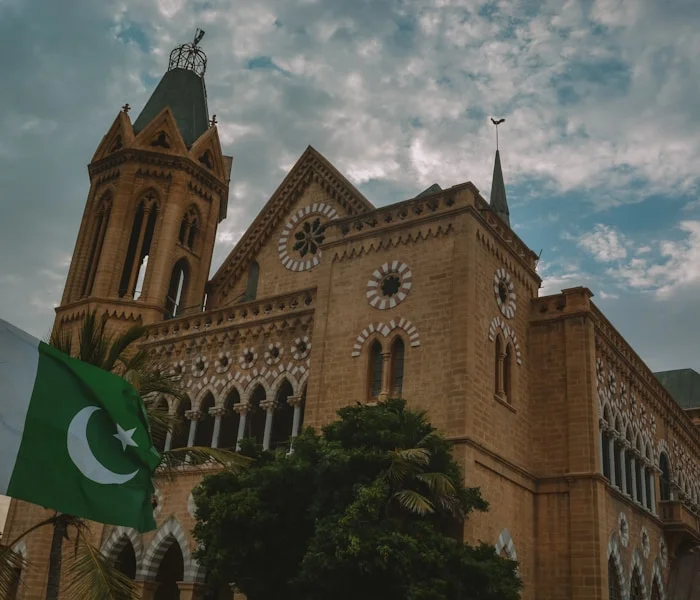
Syed Abul A‘la Maududi was born on 25 September 1903 in Aurangabad, Hyderabad Deccan, into a family known for learning, spirituality and religious commitment.
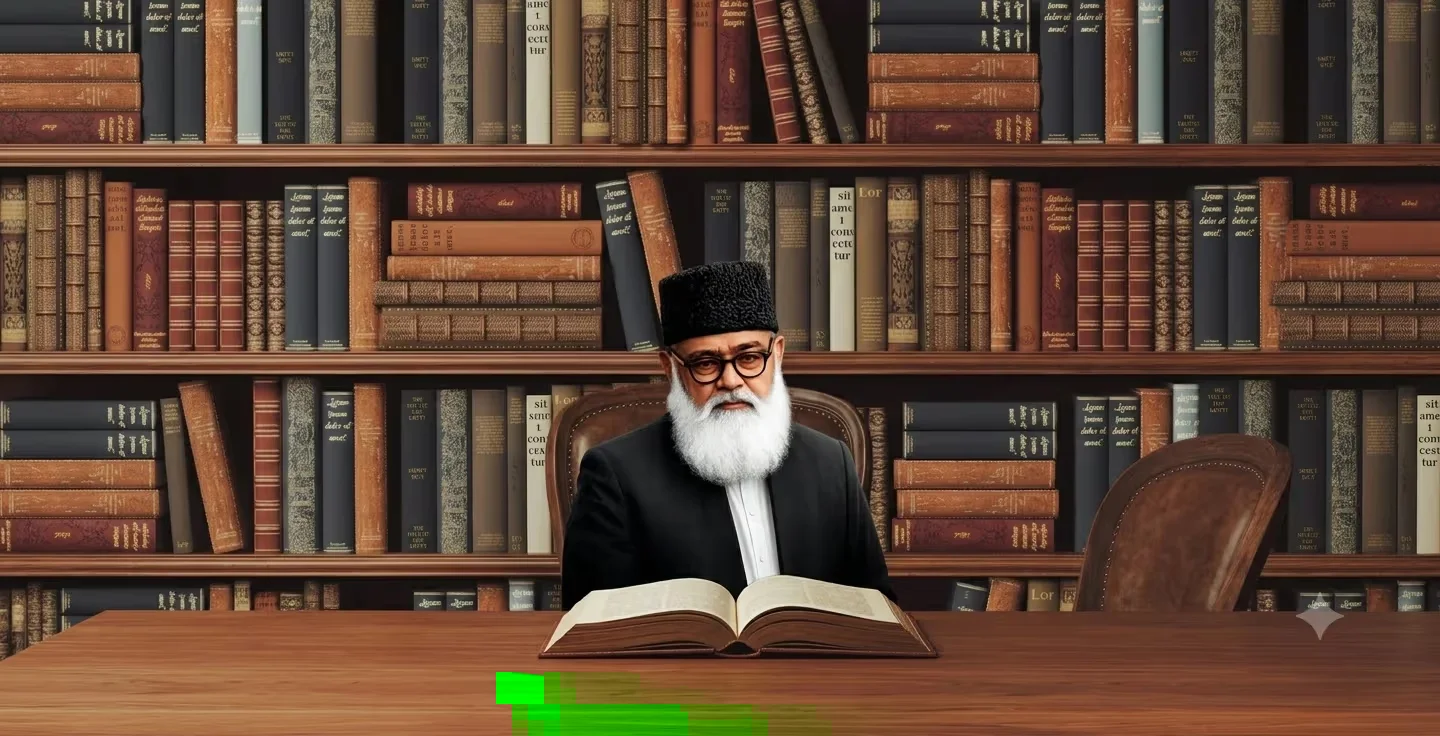
Syed Abul A'la Maududi stands among the most influential Islamic thinkers of the twentieth century. He was not merely a scholar, journalist, or political figure; he was a revivalist who rearticulated Islam as a complete system of life at a time when the Muslim world was intellectually fragmented and politically disoriented.
Born in 1903 and active as a journalist before becoming one of the most influential Muslim intellectuals of the twentieth century, Maududi built a body of thought that treated Islam as a complete framework for belief, morality, politics, and social order.
Syed Maududi’s influence extends far beyond Pakistan’s borders. His books, especially the 6-volume Tafhim-ul-Qur’an, have been translated into many languages and read worldwide. Leading Islamist thinkers in the Arab world took notice: even Egypt’s Hasan al-Banna and Sayyid Qutb studied his writings. In Iran, Ayatollah Khomeini met Maududi and helped bring his works into Persian circulation. By the mid-1960s, Maududi’s complete corpus was available in Turkey and influenced local scholars. Study circles at universities and madrasas — from Cairo to Madinah — have discussed his ideas. Several Western seekers also found guidance in his thought (for example, the American-born Maryam Jameelah and Jamaican-Canadian Dr. Bilal Philips). Even today, Islamist movements around the world echo Maududi’s terminology and goals. His intellectual presence remains alive: Jamaat’s international links and contemporary Is
A time will, then, come when communism will live in fear of its very survival in Moscow itself, when capitalist democracy will shudder at the thought of defending itself even in Washington and New York, when materialist secularism will be unable to find a place even in the universities of London and Paris, when racialism and nationalism will not win even one devotee even among the Brahmans and Germans.
Explore the Maududi Library, a curated collection of his intellectual and media legacy. Discover seminal works such as Tafhim-ul-Qur'an, Let Us Be Muslims, and Economic System of Islam, organized by theme for easy access. Browse select manuscripts, rare notes, and archival audio that reflect his voice and method.
Commentary and reflections on the Qur'an's guidance for life.
Writings on constitutional order and Islamic law.
Photographs and likenesses across his lifetime.
On social structure, culture and civilizational renewal.
Framing a just, interest-free economic order.
Letters, notes and personal papers.
Moments and milestones from the movement's history.
Recorded talks, interviews and handwritten drafts.
Original manuscripts and published book covers.
Inaugural address · Tarjuman-ul-Quran, August 1941
“The purpose of organizing faith into a dynamic movement is to ensure that personal piety does not remain a passive, isolated endeavor in our lives.”
“I was deeply grieved to hear the heartbreaking news of the passing of Maulana Syed Abul A'la Maududi. May Allah Almighty accept his lofty services for His religion and grant him a place in Jannat-ul-Firdaws.”
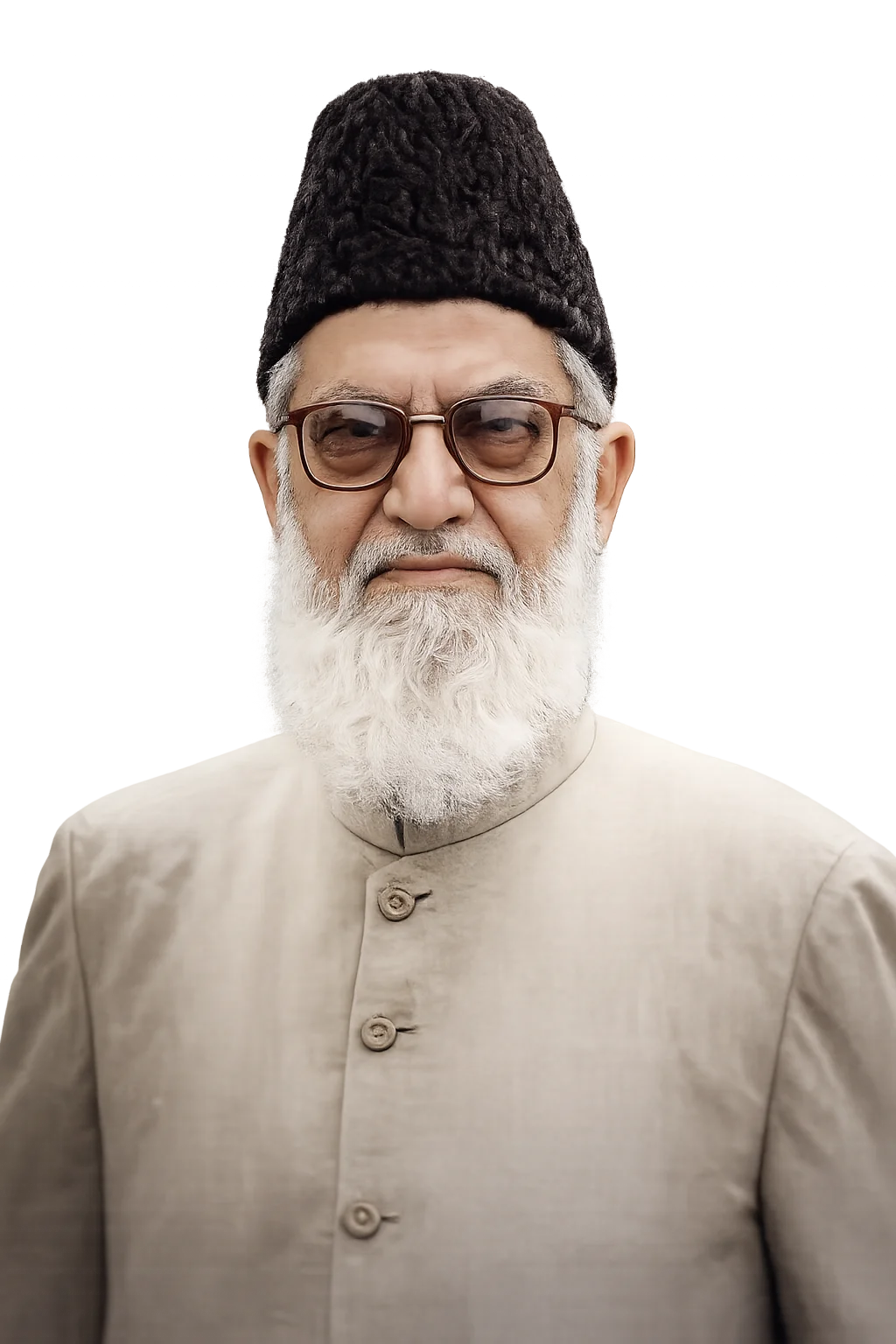
Abdulaziz ibn Abdullah Al Baz
Grand Mufti of Saudi Arabia
“The scholarly world has become fully acquainted with Maulana Maududi, and it is a fact that he is the foremost Islamic thinker and a high-ranking religious scholar of this era. The flood of atheism and irreligion that came to India from Europe; providence arranged to build a dam against it through such pure and noble hands; someone who is highly aware of and well-versed in the ancient and modern thoughts of Europe. Furthermore, he possesses such deep and clear knowledge of the Quran and Sunnah that he can discuss all contemporary issues satisfactorily in its light. This is why even the greatest atheists and secularists have surrendered their arguments before him. It can be clearly stated that the Muslims of India and the Islamic world have many religious expectations attached to Mr. Maududi.”
Allama Syed Sulaiman Nadvi
Director
“A very good journal by the name of Tarjuman-ul-Quran is being published from Hyderabad. Mr. Maududi is its editor. I have read his articles. Along with religion, he also keeps a close eye on contemporary issues. I really liked his book Al-Jihad fil-Islam . Why don't you invite him to come to Dar-ul-Islam? I believe he will accept the invitation. The greatest merit of this Al-Jihad fil-Islam is that Maulana Abul A'la Maududi has not adopted an apologetic tone in it; rather, he has presented Islam's perspectives on war and jihad without any convoluted interpretations or distortions. On the Islamic concept of jihad and its laws of peace and war, Maulana Abul A'la Maududi's book Al-Jihad fil-Islam is an excellent work. I advise every intelligent and knowledgeable person to study it.”
Allama Iqbal
“He (Maulana Maududi) possess such a personality that we have rarely seen such accomplished individuals; rather, in terms of certain distinguished characteristics, He is a unique individual whose parallel I do not find among the scholars of this era. For instance: immensely firm in supporting the truth, miles away from defensiveness and apologetics, an absolute embodiment of patience and steadfastness during trials and tribulations in the path of truth, and averse to seeking the favor of contemporary rulers. Among the scholars of Pakistan and India whom I have met or whose knowledge and excellence I am acquainted with indirectly, He possess the deepest understanding of the religion ( Tafaqquh fid-Deen ) and hold the greatest insight into the historical and legislative realities of Islam. He is an ocean of knowledge. He is highly astute and remarkably intelligent. He an expert in applying Islamic principles to contemporary issues, possess an immense capacity for deduction, and are the pioneer of a distinctly modern method of reasoning in this regard. He is intimately familiar with the temperament of the Shariah and privy to its foundational objectives, avoiding unnecessary entanglement in minutiae. He is meticulous, far-sighted, and an embodiment of conviction, the reflection of which is prominently visible in his actions and character in the form of sheer determination and steadfastness.”
Allama Sheikh Bashir Al-Ibrahimi
Director
“Today, I recall that time and state of mind when, in May 1953, I was on my way to a gathering in Rae Bareli, and someone shared a news report from an English newspaper: "A military court in Pakistan has sentenced Maulana Maududi to death." This incident affected me so deeply and struck my heart so hard that I could not stay in that gathering. That atmosphere and state of mind remain vivid in my memory to this day. At any rate, Allah the Almighty saved him at that time. Regarding this tragedy, I can say that it was not merely an incident affecting the subcontinent, but a tragedy for the entire Islamic world. I know better than you gentlemen how deep an impact the Maulana has made on the Islamic world, and especially on the youth. We hoped that Allah the Almighty would take further work from him. Maulana has also authored epoch-making books like Pardah and Huquq-uz-Zaujain . I testify before you with an open heart that, perhaps after Allama Iqbal, no one has influenced the modern mind as deeply as Maulana Maududi has. The Maulana instilled confidence in the minds of the younger generation regarding the rationality of Islam, and established the conviction that Islam can solve the problems of the present era.”
Molana Syed Abul Hassan Ali Nadvi
Stand With Us
Maududi's legacy is not a relic of the past; it's a living intellectual inheritance shaping modern Islamic discourse and organizational culture. His writings and ideas continue to inspire students, leaders and activists today. Will you be a silent observer, or join the dialogue?