Syed Ali Geelani
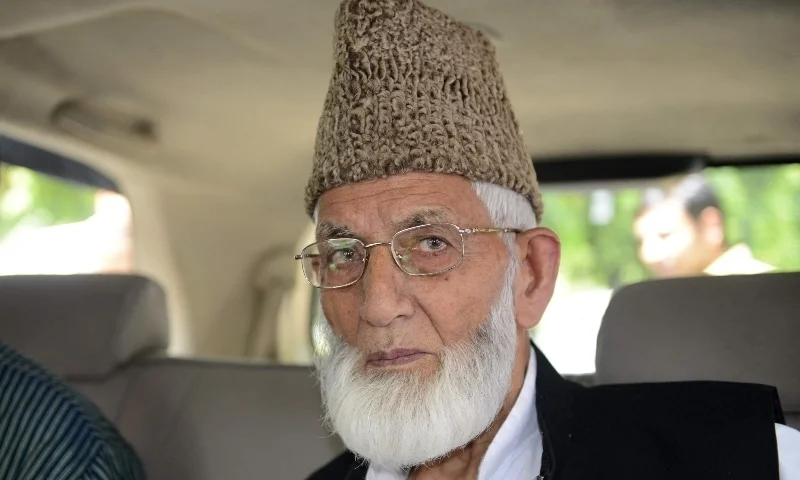
Biography & Religio-Political Contribution: Syed Ali Geelani (Rahimahullah) was the paramount leader of the Kashmiri freedom struggle and a legendary Islamic intellectual. As a lifelong champion of the right to self-determination, he spent decades in Indian prisons. He successfully merged the political struggle of Jammu and Kashmir with the broader Islamic identity of the region, rejecting any compromise with Indian occupation.
Impact on the Ummah: Geelani stood as an unyielding fortress against the ideological and physical subjugation of Muslims in South Asia. His historic slogan, “Hum Pakistani hain, Pakistan hamara hai”, grounded the Kashmiri resistance in the Two-Nation Theory. He taught the Ummah the meaning of Istiqamat (steadfastness) in the face of brutal oppression.
Connection with Jamaat-e-Islami: Geelani was intellectually nurtured by the literature of Maulana Maududi. He served as the Amir of Jamaat-e-Islami Jammu and Kashmir for years, making JI the vanguard of the Kashmiri resistance. Even after forming Tehreek-e-Hurriyat to broaden the political base, his ideological core remained strictly Maududian. JI Pakistan reveres him as the "Syed of Martyrs" of the modern era, holding absentia funeral prayers for him nationwide.
Urdu Publications: An accomplished Urdu author, his monumental prison diary Rudaad-e-Qafas and Iqbal: Rooh-e-Deen Ka Shanasa remain profoundly influential in Tehreek-e-Islami circles.
Biography
Syed Ali Geelani (Rahimahullah) is widely regarded as one of the towering figures of South Asia, and for nearly seven decades, his name has become inseparable from Kashmir’s resistance movement and firmly embedded in its present and future.
His life was defined by willingness to suffer for truth. To his critics, he was uncompromising to a fault. Yet everyone agreed on one thing: Geelani was a man of extraordinary conviction.
Born on 29 September 1929 in a modest village in Indian-occupied Kashmir, Geelani emerged from circumstances far removed from the prominence he would later attain. His Intellectual journey eventually took him to Lahore, where he studied at Oriental College and immersed himself in Arabic, Persian, Urdu, Islamic studies, and classical literature.
The writings of Maulana Abul Ala Maududi left a particularly deep impression on him. Through Jamaat-e-Islami, he found an intellectual framework that sought to integrate faith, society, and politics into a single moral vision. It was a framework he would carry with him for the rest of his life. Even when his political strategies evolved, the foundations of his worldview remained remarkably consistent.
He rose through the ranks of Jamaat-e-Islami Jammu and Kashmir and eventually became one of its most influential leaders. A defining feature of Geelani’s political life was his insistence that India’s military occupation of Kashmir could not be reduced to administrative arrangements or constitutional formulas.
In his view, it was fundamentally a question of self-determination, identity, and freedom: Azadi. This view came at a significant personal cost. Geelani spent years in prisons, detention centres, and under house arrest. By the final decade of his life, much of his existence was spent confined by Indian forces within the walls of his residence in Hyderpora, Srinagar.
Even after forming Tehreek-e-Hurriyat in 2004 to broaden the political base, his ideological core remained strictly Maududian. Jamaat-i-Islami Pakistan reveres him as the “Syed of Martyrs”.
Those who met him personally frequently spoke not of fiery rhetoric but of discipline. He would quickly return to two subjects: Islam and Kashmir. For Geelani, the two were inseparable. He regarded Kashmir as a moral obligation rather than merely a political objective. Among the many words associated with Geelani, none appears more frequently than Istiqamat— steadfastness.
His famous slogan, “Hum Pakistani hain, Pakistan hamara hai”, emerged from this broader ideological outlook, grounded in the two-nation theory. Prison became a recurring feature of Syed Ali Geelani’s life. His first major arrest came in 1962, and he spent approximately thirteen months behind bars.
Three years later, he was arrested again and remained incarcerated for nearly twenty-two months. After 1987, he was detained in several infamous Indian jails, like Jodhpur jail. Geelani spent more than a dozen years in prison and many additional years under preventive detention and house arrest.
Yet he rarely spoke of imprisonment solely as a burden. Instead, he transformed confinement into a space for reflection. In his later years, the prison walls were replaced by the walls of his home in Hyderpora, Srinagar.
From 2010 onwards, he spent much of the final decade of his life under prolonged house arrest, effectively turning his residence into another form of prison. His intellectual formation was rooted in a deep engagement with the Quran, Islamic history, Urdu literature, and the writings of Maulana Abul Ala Maududi.
He authored dozens of books, essays, prison reflections, and political commentaries. His writings reveal a deep engagement with questions of faith, history and Muslim identity. At the soul of his writings are Moulana Maududi’s commentaries on the Quran; at the heart is Iqbal’s philosophy, and the flow is deep-rooted in Persian poetry. Among his most influential works is Rudaad-e-Qafas, a prison memoir that combines personal experience with political reflection.
Another important work, Iqbal: Rooh-e-Deen Ka Shanasa, demonstrates his profound engagement with the thought of Allama Iqbal. He also devoted significant effort to translating and interpreting aspects of Iqbal’s Persian writings for Urdu readers.
Works such as Nawa-e-Hurriyat, Did-o-Shuneed, Maqtal Se Wapsi, Wullar Kinare: Aap Beeti, Sada-e-Dard, and Millat-e-Mazloom reveal the breadth of his interests, ranging from contemporary politics and Islamic thought to personal reminiscence and historical reflection.
When Syed Ali Geelani left this mortal world on 1 September 2021, confined within the walls of his own home, it was not merely the passing of a man. It was the silencing of a voice that had refused silence for decades. Geelani left behind more than a political legacy.
He left behind a grammar of resistance, one forged in Islam, resistance and persistence. He became a symbol of an unyielding refusal to accept injustice as destiny.
Beyond Kashmir, his life spoke to a larger community of the dispossessed, the occupied, and the forgotten across the world. In life, he stood in defiance of power. In death, he remains part of a continuing struggle.