Sheikh Yusuf al-Qaradawi (1926–2022)
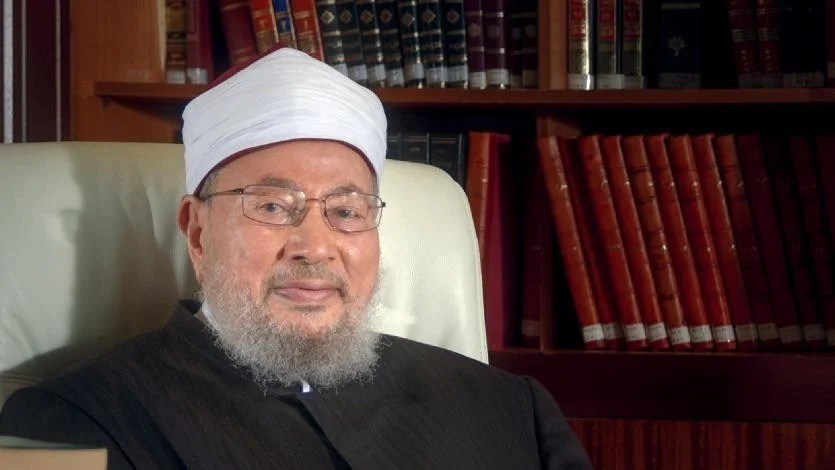
Allama Sheikh Yusuf Abdullah al-Qaradawi was born on September 9, 1926, in Saft Turab, a village in the El Mahalla El Kubra centre of Gharbia Governorate, Egypt. This village is known in Islamic history as the place where Abdullah bin al-Harith bin Jaz‘ al-Zubaidi, the last Companion of the Prophet ﷺ to pass away in Egypt, is buried.
Sheikh al-Qaradawi became one of the most widely read and heard Muslim scholars of the modern age. He was an Egyptian-born scholar who later acquired Qatari citizenship, a jurist, writer, preacher, intellectual, educationist, and movement leader. He was the principal founder and former head of the International Union of Muslim Scholars, and also served as President of the European Council for Fatwa and Research.
Early Life and Quranic Education
Sheikh Yusuf al-Qaradawi lost his father at the age of two. His uncle then took responsibility for his upbringing. From childhood, he showed a strong attachment to the Qur’an and religious learning. Before the age of ten, he had memorised the Holy Qur’an and mastered the rules of Tajweed.
He received his early education in Al-Azhar institutes, where he consistently remained among the top students of his class. In his secondary certificate, he stood second in the Egyptian Kingdom, even though he was passing through a period of political detention.
Academic Journey at Al-Azhar
Sheikh al-Qaradawi’s formal education was rooted in Al-Azhar. His academic record showed both brilliance and discipline.
In 1952–1953, he graduated from the Faculty of Usul al-Din at Al-Azhar University with the Al-‘Aliyah degree, ranking first among 180 students.
In 1954, he obtained the Al-‘Alamiyyah degree with a teaching licence from the Faculty of Arabic Language, ranking first among 500 graduates across Al-Azhar’s three main faculties.
In 1958, he earned a specialised diploma in Language and Literature from the Institute of Higher Arab Studies.
In 1960, he completed preliminary higher studies, equivalent to a Master’s degree, in the Department of Qur’an and Sunnah Sciences at the Faculty of Usul al-Din.
In 1973, he was awarded a PhD with first-class honours from the same faculty. His doctoral dissertation was titled: “Zakat and its Effect in Solving Social Problems.” This thesis later became the foundation of one of his most important works, Fiqh az-Zakat.
Early Career in Egypt
Da‘wah remained the centre of his life from the beginning. He began preaching at the age of sixteen in his own village and gradually became one of the most recognisable Islamic voices in the Arab world.
Before his move to Qatar, Sheikh al-Qaradawi worked as a preacher and teacher in mosques. He then became a supervisor at the Imams’ Institute under the Egyptian Ministry of Awqaf.
Later, he was transferred to the General Administration of Islamic Culture at Al-Azhar, where he supervised publications and worked in the technical office for da‘wah and guidance.
Association with the Muslim Brotherhood
From his youth, Sheikh al-Qaradawi chose the path of Islamic revival associated with Imam Hasan al-Banna and Al-Ikhwan al-Muslimun. He connected early with the Muslim Brotherhood, toured Egypt and the Levant while still a student, and worked to spread its message.
He was not merely a scholar who observed the Islamic movement from a distance. He lived inside its struggles, prisons, debates, and responsibilities.
He was imprisoned several times because of his Islamic activism:
- In 1949, he was imprisoned under the monarchy of King Farouk.
- In 1954, he was jailed twice under Gamal Abdel Nasser, first in January and then in November.
- He spent nearly 20 months in prison during this period.
- In 1963, he was imprisoned again because of his ideological and movement affiliations.
Sheikh al-Qaradawi remained a strong defender of the Muslim Brotherhood throughout his life. He wrote the historical work Al-Ikhwan al-Muslimun: 70 Years of Preaching, Education, and Jihad, recording the movement’s history, social service, da‘wah, training, and cultural contribution.
He held that Imam Hasan al-Banna’s method was not a memory of the past, but a practical programme that needed implementation. During the Arab Spring, he welcomed the democratic election of the Muslim Brotherhood’s government in Egypt and described them as the desired moderate Islamic party. He praised the Ikhwan as among the most steadfast and pure groups in Egypt in conduct, morals, and thought.
At the same time, he believed in constructive self-criticism inside Islamic movements. He accepted the presence of multiple Islamic groups, provided that this plurality remained a diversity of specialisation rather than contradiction, rivalry, or division.
Palestine and the 1948 Struggle
The question of Palestine remained central to Sheikh al-Qaradawi’s life and thought. During the 1948 period, when Muslim Brotherhood volunteers took part in military campaigns against Zionist militias in Palestine, Yusuf al-Qaradawi also participated in that atmosphere of mobilisation and struggle. He also lost comrades during one such military operation against oppressors.
This early connection with Palestine shaped his later voice on the issue. For him, Palestine was not a distant political subject. It was a question of faith, justice, land, sanctity, and the collective responsibility of the Ummah.
Migration to Qatar and Long Exile
Because of continuous state hostility in Egypt, Sheikh al-Qaradawi moved to Qatar in 1961. He was initially loaned to Qatar as Dean of its Secondary Religious Institute. He developed and stabilised the institution by combining beneficial traditional methods with valid modern educational approaches.
He later acquired Qatari citizenship and settled there permanently. His exile from Egypt extended across decades, yet he carried it with patience and did not turn his personal suffering into complaint. His work expanded in Qatar and reached the wider Muslim world.
Qatar University and Academic Leadership
In 1973, when the Faculties of Education for men and women were established as the nucleus of Qatar University, Sheikh al-Qaradawi was transferred to found and head the Islamic Studies Department.
In 1977, he officially established the Faculty of Sharia and Islamic Studies at Qatar University and served as its Dean until the end of the 1989–1990 academic year.
He also became the founding director of the university’s Seerah and Sunnah Research Center, an institution dedicated to the study of the Prophet’s life, Sunnah, and guidance.
In 1990–1991, he was loaned to Algeria, where he headed the scientific councils of its universities and higher Islamic institutes. He later returned to his research work in Qatar.
A Scholar of Authorship and Renewal
Sheikh al-Qaradawi wrote with the mind of a jurist, the warmth of a preacher, the discipline of a teacher, and the concerns of a reformer. Maulana Abul Hasan Ali Nadwi described him as an investigative author. He did not write merely to repeat old discussions. He wrote where correction, clarification, refutation, or renewal was needed.
His works were rooted in the Qur’an, Sunnah, and the methodology of the pious predecessors, while also engaging the modern age with directness. His books joined academic scrutiny, intellectual reflection, reformist concern, and accessible language.
His writing avoided blind imitation, sectarian rigidity, and ideological dependence on either the East or the West. It carried a clear line of moderation, neither harsh extremism nor careless laxity. It also defended the Ummah against external ideological invasion and internal confusion.
He authored more than 50 major books, while his wider body of books, booklets, fatwas, lectures, edited material, and writings is often counted near 200 works. Many of these works were translated into more than 45 languages.
Major Works
Sheikh al-Qaradawi’s writings covered law, worship, Islamic economics, the state, Muslim minorities, da‘wah, poverty, jihad, Qur’anic studies, Sunnah, education, and modern social questions.
Among his major works are:
- Al-Halal wal Haram fil Islam (The Lawful and the Prohibited in Islam)
- Fiqh az-Zakat (The Jurisprudence of Zakat)
- Fiqh at-Taharah (Jurisprudence of Purity)
- Fiqh as-Salah (Jurisprudence of Prayer)
- Fiqh al-Jihad (The Jurisprudence of Jihad)
- Min Fiqh ad-Dawlah fil Islam (Jurisprudence of the State in Islam)
- Fi Fiqh al-Aqalliyat al-Muslimah (Jurisprudence of Muslim Minorities)
- Kaifa Nata‘amal ma‘a al-Qur’an al-Azeem (How to Interact with the Noble Qur’an)
- Kaifa Nata‘amal ma‘a as-Sunnah (How to Interact with the Sunnah)
- Mushkilat al-Faqr wa Kaifa ‘Alajaha al-Islam (The Problem of Poverty and Islam’s Solution)
- Fatawa Mu‘asirah (Contemporary Fatwas)
- The Fatwa between Discipline and Laxity
- The Inevitability of the Islamic Solution
- The Lesson of the Second Disaster
- Islam and Secularism Face to Face
- Bank Interests are Forbidden Riba
- The Phenomenon of Extremism in Takfir
- The Scholar and the Tyrant, a play on Saeed bin Jubayr and Al-Hajjaj
- Breezes and Blazing Fires, a poetry collection
He also wrote more than 20 textbooks for the Qatari Ministry of Education.
The Lawful and the Prohibited in Islam
One of Sheikh al-Qaradawi’s earliest and most famous works was Al-Halal wal Haram fil Islam. It was commissioned by Al-Azhar during the time of Sheikh Mahmud Shaltut.
The book became widely read across the Muslim world, translated into more than a dozen languages, and studied in academic settings. including different universities of Pakistan. The scholar Al-Albani investigated its Hadith references.
Its importance lay in the fact that it addressed ordinary Muslim life in a clear, practical, and evidence-based manner. It helped Muslims understand what is lawful and unlawful without making religion inaccessible to the common reader.
Fiqh az-Zakat
Fiqh az-Zakat became one of Sheikh al-Qaradawi’s most important works. It was a two-volume encyclopedic and comparative study of zakat, its legal foundations, social objectives, and economic impact.
Syed Abul A‘la Maududi described it as the book of the century in Islamic jurisprudence. It was later translated into English by the Islamic Economics Center of King Abdulaziz University. The book showed that zakat is not a symbolic act only. It is a serious social and economic institution capable of addressing poverty, inequality, and public welfare when understood and implemented properly.
Contemporary Fatwa and Fiqh
Sheikh al-Qaradawi became a major reference for Muslims across the world in matters of fatwa. Questions reached him through conferences, letters, telephone calls, public gatherings, and later through mass media.
His fatwa method rested on facilitation without carelessness, evidence over blind imitation, and attention to the real circumstances of people. He explained his reasoning rather than issuing unexplained rulings.
He was a member of the Fiqh Council of the Muslim World League and an expert at the Islamic Fiqh Academy of the Organisation of Islamic Cooperation.
Through the European Council for Fatwa and Research, he helped institutionalise Islamic legal guidance for Muslims living in the West. He gave special attention to fiqh al-aqalliyat, the jurisprudence of Muslim minorities, so that Muslims in Europe and other non-Muslim societies could preserve their faith while living responsibly in their circumstances.
Islamic Economics and the Question of Riba
Sheikh al-Qaradawi was a firm voice in Islamic economics. His work addressed poverty, zakat, murabaha, Islamic banking, trade, and the prohibition of interest.
In a detailed 1989 interview, later published in Urdu under the title Bank Interest, he used academic proofs to establish that all forms of bank interest are riba and forbidden by scholarly consensus.
He served as a volunteer Sharia adviser to the first Islamic bank, Dubai Islamic Bank, and later sat on the Sharia supervisory boards of several major Islamic financial institutions.
He was head of Sharia supervisory boards for:
- Qatar Islamic Bank
- Qatar International Islamic Bank
- Faisal Islamic Bank, Bahrain and Karachi
- Bank Al-Taqwa, Switzerland
His contribution to Islamic economics was recognised by the Islamic Development Bank Prize in Islamic Economics in 1411 AH / 1990–1991.
Da‘wah, Pulpit, and Public Guidance
Da‘wah was the heartbeat of Sheikh al-Qaradawi’s work. He began preaching as a teenager and remained attached to the pulpit throughout his life.
He preached to large gatherings at the Aal Taha Mosque in El Mahalla El Kubra, then at the Zamalek Mosque in Cairo, and later at the Omar bin al-Khattab Mosque in Qatar, where his sermons were broadcast live.
He delivered major Eid sermons, held weekly lessons, conducted well-known Ramadan sessions often attended by Qatari leadership, and led Taraweeh prayers, completing the Qur’an annually.
Through radio and television, his voice reached millions. His programmes included Light and Guidance on radio and the long-running television programme Guidance of Islam. He also wrote frequently in Islamic magazines and journals in Egypt, Syria, Kuwait, Lebanon, India, Saudi Arabia, Qatar, and the United Arab Emirates.
Conferences and Scholarly Participation
Sheikh al-Qaradawi participated in major international conferences and scholarly gatherings. He did not attend as a ceremonial figure; he prepared research, presented arguments, and contributed actively to discussions.
His major participations included:
- The First Global Conference on Islamic Economics in Makkah
- Da‘wah and fiqh conferences in Madinah and Riyadh
- The Anti-Intoxicants Conference in Madinah
- Festivals and scholarly gatherings of Nadwatul Ulama in India
- The conference on Islam and Orientalists, where he was unanimously elected president
- Symposia on Islamic banking, zakat, medical sciences, and Islamic civilisation across Europe, the Arab world, and Asia
He also visited universities and academic institutions across the world to address students, scholars, and Muslim communities.
University Visits and Global Lectures
Sheikh al-Qaradawi lectured at major universities and institutions in many countries. In Egypt, he addressed audiences at Cairo University, Al-Azhar, Ain Shams, Alexandria, Mansoura, and Assiut.
In Sudan, he visited Khartoum and Omdurman. In Saudi Arabia, he spoke at the Islamic University of Madinah, King Abdulaziz University, King Faisal University, King Saud University, and Dhahran University.
He also visited academic and Islamic institutions in Kuwait, the United Arab Emirates, Bahrain, Jordan, Morocco, Yemen, Algeria, Pakistan, Malaysia, India, Nigeria, Indonesia, the Philippines, Japan, and South Korea.
In Pakistan, his visits included institutions such as the International Islamic University Islamabad and Punjab University. In Malaysia, he visited institutions including International Islamic University Malaysia and the University of Malaya.
He also regularly visited Muslim minorities and youth groups in Europe, the Americas, and Australia, guiding them against cultural assimilation on one side and extremism on the other.
Councils and Institutions
Despite a demanding schedule, Sheikh al-Qaradawi remained active in many councils, institutions, and advisory bodies. He served on or remained associated with:
- Supreme Education Council, Qatar
- Sharia Fatwa Board, Qatar
- Fiqh Council of the Muslim World League
- Islamic Fiqh Academy of the OIC
- Board of Trustees, Islamic Dawah Organization, Khartoum
- Board of Trustees, International Islamic University Islamabad
- Oxford Centre for Islamic Studies
- International Islamic Charitable Organization, Kuwait
- Islamic Economics Association, Cairo
He was also a founding member of several Islamic academic, charitable, and economic bodies.
Social and Charitable Work
Sheikh al-Qaradawi repeatedly reminded Islamic movements that political activity alone was not enough. He criticised the neglect of social and charitable work and warned that this vacuum could be exploited by adversaries, including well-funded missionary campaigns targeting vulnerable Muslim communities.
He initiated the campaign “Pay a Dollar to Save a Muslim” to counter large missionary budgets. He also conceived and helped establish the International Islamic Charitable Organization in Kuwait.
He established the Qatar Islamic Fund for Zakat and Charity.
In his own village, he personally funded and built the Sahwa Mosque, an institute, and a hospital. He also funded and built the Al-Rahma Mosque in Nasr City, Egypt.
For him, da‘wah had to be visible in service. A hungry person, a poor family, a neglected village, and a confused young Muslim all had claims on the Islamic movement.
Guiding the Islamic Awakening
Sheikh al-Qaradawi gave great attention to the modern Islamic awakening, especially Muslim youth. He had the trust of young activists because he combined knowledge, movement experience, broad-mindedness, and moderation.
He strongly opposed the wave of reckless takfir, mass excommunication, and wrote The Phenomenon of Extremism in Takfir to correct this danger.
He urged Islamic workers and youth to move:
- From argument to action
- From minor branches to major foundations
- From disputed issues to agreed-upon principles
- From dreams detached from reality to grounded work
- From isolation to social engagement
- From harshness to gentleness in da‘wah
He believed the Islamic movement represents the conscious voice of the Ummah. The decline of the Ummah was not caused by the movement alone; it came from long historical stagnation, colonial domination, and internal weakness. Yet the movement remains accountable for the resources, opportunities, and responsibilities it possesses.
He kept the door of ijtihad open and treated constructive criticism as necessary for renewal. He strongly criticised those who merely “wait in line” for an Islamic state while doing little to serve people in the present.
Relationship with Maulana Maududi and Jamaat-e-Islami
Sheikh al-Qaradawi shared deep ideological harmony with Jamaat-e-Islami and its founder, Syed Abul A‘la Maududi. He held that the da‘wah foundations and final objectives of the Muslim Brotherhood in Egypt and Jamaat-e-Islami in Pakistan were the same.
He was deeply influenced by Maududi’s method of Islamic revival and wrote a detailed study of his thought titled: Nazarat fi Fikr al-Imam al-Maududi (Perspectives on the Thought of Imam Maududi).
For Jamaat-e-Islami, this linkage was not ceremonial. Successive Ameers and members of Jamaat’s Shura (Central Council) would regularly visit Sheikh al-Qaradawi in Qatar. Abdul Ghaffar Aziz, the director of JI Foreign Affairs was one of his proteges.The connection reflected a shared vision: Islam as a complete way of life, da‘wah joined with tarbiyah, social reform linked with political responsibility, and the struggle for the establishment of Deen.
The Funeral of Maulana Maududi
After Maulana Maududi passed away in September 1979, Sheikh al-Qaradawi came to Pakistan to attend his funeral. Veteran Jamaat leader Liaqat Baloch, who was then head of Islami Jamiat-e-Talaba, was assigned protocol duties for international guests. He personally received Sheikh al-Qaradawi at Lahore Airport on September 28, 1979.
According to Liaqat Baloch, Sheikh al-Qaradawi was restless after arriving at the hotel. He wanted to go immediately to Maulana Maududi’s residence in Ichhra, Lahore, to see for the last time the man he regarded as his teacher, Imam, and guide.
The funeral prayer was held at Gaddafi Stadium, Lahore, where a massive crowd had gathered. It was initially expected that the Imam of the Kaaba, Sheikh Muhammad bin Subayyil, would lead the prayer. When he could not arrive in time, the honour of leading the funeral prayer fell to Sheikh al-Qaradawi.
Before the prayer, he delivered a brief speech. His words carried love, grief, and recognition of Maududi’s place in the Islamic movement. Those present felt that he had fulfilled the right of leading Maulana Maududi’s final prayer.
Professor Khurshid Ahmad’s Tribute
Professor Khurshid Ahmad wrote that after the passing of Maulana Maududi in 1979, the death of Sheikh Yusuf al-Qaradawi was the second heaviest sorrow of his life. In his article published in Tarjuman-ul-Quran, he termed their relationship as warm and respectful.
He described Sheikh al-Qaradawi through six defining qualities.
1. A Life of Sacrifice
He gave his youth, dreams, comfort, and material future to the cause of Islam. He spent decades away from his homeland and carried exile without complaint.
2. Intellectual Versatility
He used every intellectual and literary tool available to him. He combined Qur’anic reasoning with logic, strong oratory with calm advocacy, and historical evidence with contemporary relevance. His writings blended theology, sociology, law, movement thought, and literary strength.
3. The Teacher
He remained a teacher at heart. He helped modernise Islamic education systems in universities across Algeria, Morocco, Sudan, and Qatar, and guided educational reform in non-Arab countries such as Pakistan, Indonesia, Malaysia, and Turkey.
4. The Activist and Leader
He was not an isolated scholar. He was a practical leader of the revivalist movement. He wrote on organisation, training, internal movement dynamics, and the art of turning disagreement into progress rather than division.
5. The Economist and Jurist
He understood the economic suffering of modern humanity. His Fiqh az-Zakat remains one of the strongest works on zakat, poverty eradication, trade principles, and interest-free banking.
6. The Defender of the Faith
At a time when Muslims faced the combined pressure of the modern state, media, military power, and Western imperial dominance, he wrote Fiqh al-Jihad. Through it, he gave a balanced and thoroughly researched direction that rejected both external aggression and the confusion of extremism or passivity among Muslim youth.
Awards and Honours
Sheikh al-Qaradawi received major awards for his contributions to Islamic thought, jurisprudence, economics, and education.
His honours included:
- Islamic Development Bank Prize in Islamic Economics, 1411 AH / 1990–1991
- King Faisal International Prize for Islamic Studies, 1413 AH
- Distinguished Academic Contribution Award from the President of the International Islamic University Malaysia, 1996
- Sultan Hassanal Bolkiah Award for Islamic Jurisprudence, Brunei, 1997
Death
Sheikh Yusuf al-Qaradawi passed away on September 26, 2022, at the age of 96.
He left behind a body of work that continues to shape Islamic scholarship, Muslim minority thought, Islamic economics, modern fatwa, da‘wah, and the intellectual direction of Islamic movements.
Legacy
Sheikh Yusuf al-Qaradawi belonged to the generation that carried the Islamic movement from the age of colonialism and monarchy into the modern age of nation-states, media, universities, migration, ideological conflict, and global Muslim minorities.
He combined the jurist’s discipline, the preacher’s heart, the teacher’s patience, the writer’s clarity, and the movement worker’s commitment. He served Islam through the pulpit, the book, the university, the fatwa council, the charitable institution, the Islamic bank, the youth gathering, and the global conference.
May Allah elevate his ranks. Aameen.