The Rohingya Question
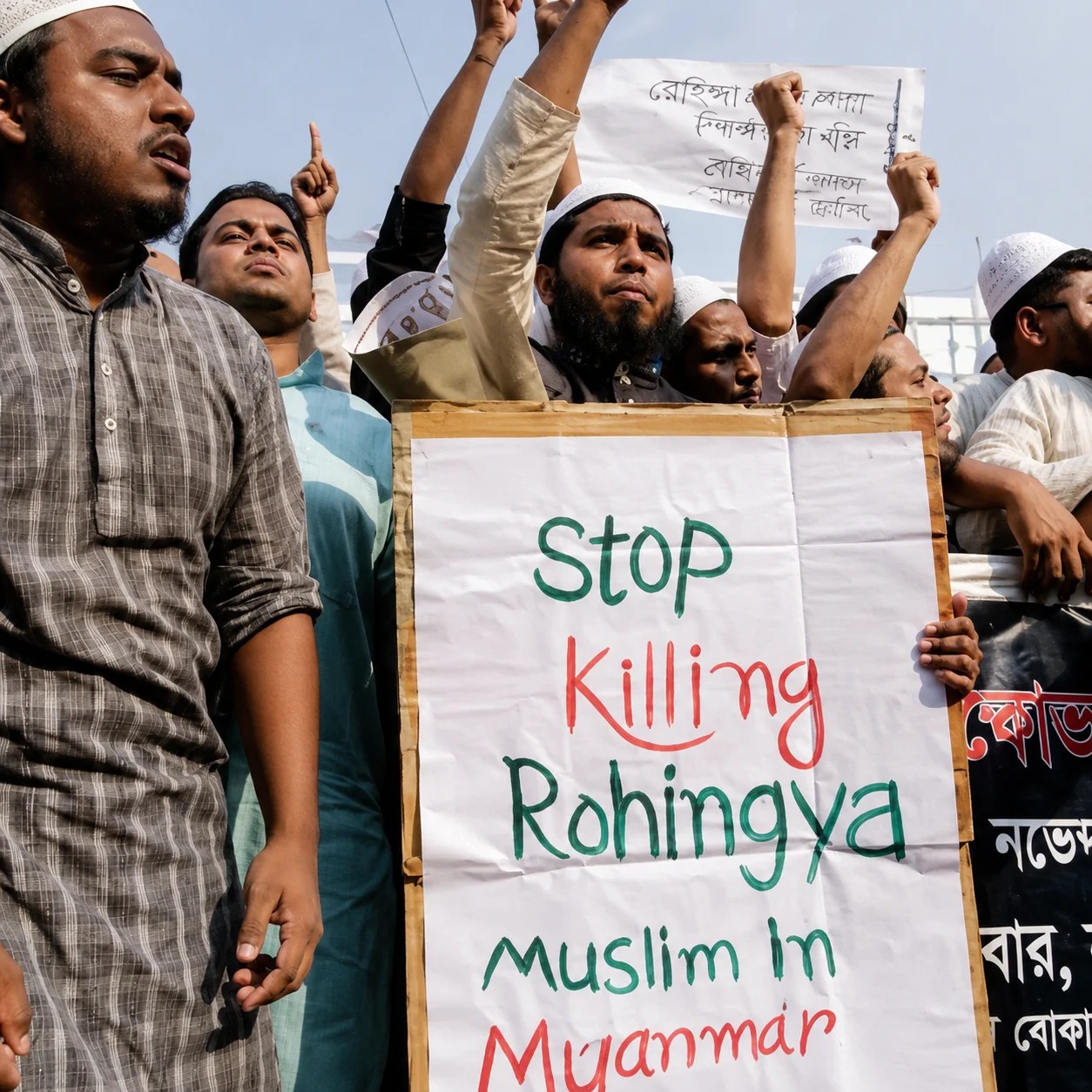
Standing With a Persecuted and Stateless Muslim People
The suffering of the Rohingya is one of the clearest examples of the failure of the international order to protect a persecuted people. For decades, the Rohingya Muslims of Myanmar’s Rakhine State have faced systematic discrimination, restrictions on movement, denial of citizenship, destruction of villages and repeated military operations. The violence of 2017 forced hundreds of thousands across the border into Bangladesh, where more than a million Rohingya now live in overcrowded camps around Cox’s Bazar.
For Jamaat-e-Islami, the Rohingya issue is not merely a refugee-management problem. It is a question of human dignity, Islamic brotherhood, citizenship, justice and the right of a people to live securely in their ancestral homeland. Jamaat rejects any attempt to erase the Rohingya identity by describing them simply as illegal migrants or outsiders.
The continuing proceedings before the International Court of Justice have kept the question of genocide and state responsibility before the international community. Yet judicial proceedings alone cannot feed families, educate children or protect refugees from disease, fire, floods and landslides. Conditions in Cox’s Bazar remain dangerous, while declining international assistance has increased hunger, insecurity and the risk of human trafficking.
Relief in Cox’s Bazar
Alkhidmat has treated the Rohingya crisis as a continuing humanitarian responsibility rather than a short-lived emergency. Through camp-based relief and cooperation with humanitarian partners, assistance has included food, shelter, clean water, healthcare, seasonal support and help for vulnerable families.
The objective has not been to make refugees permanently dependent upon aid. It has been to preserve life, dignity and hope until a safe and lasting political settlement becomes possible.
Educational and Islamic literature has also been distributed where local regulations allowed. For displaced families, religious education and access to the Qur’an are important means of preserving identity, morality and community cohesion. Such work must always be carried out respectfully and must never make humanitarian assistance conditional upon religious participation.
Jamaat believes that children raised in camps must not become a lost generation. Alongside food and shelter, they require education, vocational skills, psychological care and protection from traffickers, criminal networks and forced recruitment.
The Rohingya Community in Karachi
Karachi has hosted Rohingya and other Burmese-origin Muslim communities for decades, particularly in neighbourhoods such as Burma Colony and Arakanabad. Their precise number is disputed, but they form a significant and long-established part of the city’s working population. Many have faced difficulty obtaining identity documents, school admission, lawful employment, healthcare and access to public services.
Jamaat’s approach is based on rehabilitation and lawful inclusion. People who have lived in Pakistan for generations should not remain permanently invisible to the state. Their cases should be examined through a transparent documentation process that distinguishes long-settled families, refugees, citizens, undocumented migrants and persons at risk of statelessness.
Jamaat and Alkhidmat workers have supported vulnerable families through relief, education, healthcare and local community contact. This service reflects Jamaat’s established tradition of working among neglected urban populations without discrimination based on ethnicity or language.
A Policy for Justice and Repatriation
Jamaat-e-Islami calls for:
- Restoration of citizenship and fundamental rights for the Rohingya in Myanmar.
- Accountability for mass killings, sexual violence, forced displacement and destruction of settlements.
- Safe, voluntary and dignified repatriation under credible international monitoring.
- Continued international support for Bangladesh, which has carried a disproportionate humanitarian burden.
- Education, healthcare and livelihood opportunities for refugees while displacement continues.
- Protection of Rohingya families in Pakistan from statelessness, exploitation and arbitrary displacement.
- A permanent OIC mechanism for Muslim refugee populations.
Repatriation cannot mean returning people to the same conditions from which they fled. The Rohingya must return as recognised citizens with security, land rights, freedom of worship and international guarantees.
The Rohingya question tests whether the Muslim world can move beyond statements of sympathy. Jamaat’s position is that relief must continue, but relief must be joined by sustained diplomatic, legal and political action until the Rohingya can live with dignity and security.