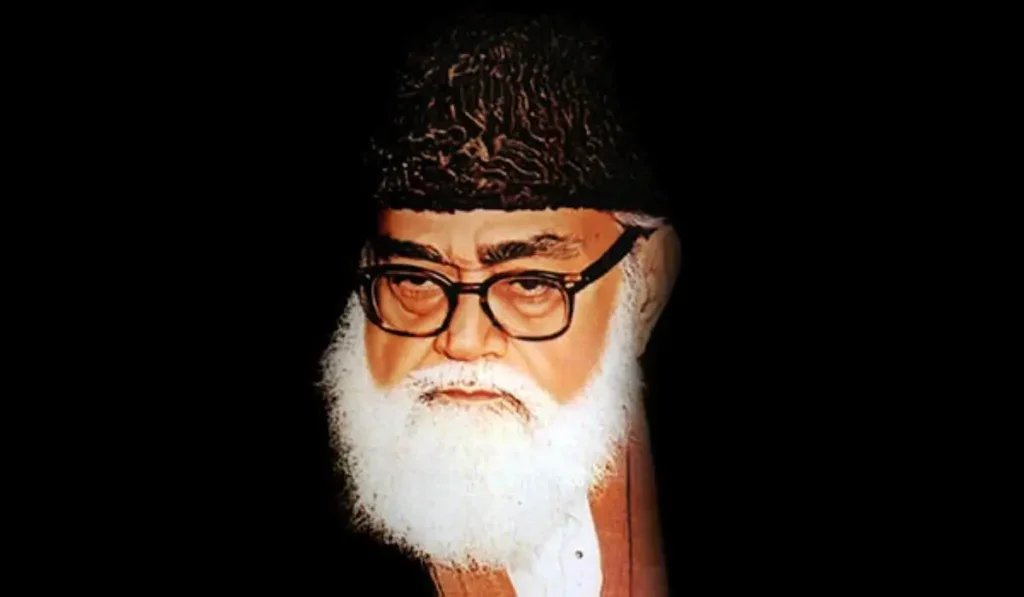
Detailed Bio – Syed Abul A‘la Maududi
Early Life and Intellectual Formation
Birth, Lineage, and Spiritual Heritage
Abul A‘la Maududi was born on Rajab 3, 1321 A.H. (September 25, 1903 C.E.) in Aurangabad, a well-known town of the former princely state of Hyderabad (Deccan), now in India. He was born into a respectable family whose paternal lineage is traced back to the Holy Prophet (peace be upon him).
The family had a long-standing tradition of spiritual leadership. Several of Maududi’s ancestors were associated with Sufi orders, most notably Khwajah Qutb al-Din Maudud (d. 527 A.H.), a distinguished figure of the Chishti order, from whom the family derives its name. His forefathers migrated from Chisht to the Indo-Pakistan subcontinent towards the end of the ninth century A.H.
His father, Ahmad Hasan (b. 1855 C.E.), was a lawyer by profession and a deeply religious and devout man. The environment of piety, discipline, and moral responsibility within the household played a defining role in shaping Maududi’s character and outlook.
***
Early Education and First Writings
Syed Maududi received his early education at home in Arabic, Persian, and English. In 1913, after completing this initial education, he was admitted to the Rushdiya grade of Madrasa Fauqania.
His literary and religious abilities appeared early. In 1915, while still a young boy, he wrote a brief treatise on the biography of the Holy Prophet Muhammad ﷺ.
In 1915, he translated Al-Mar’ah al-Jadidah, an Arabic work by Qasim Amin, into Urdu. The book dealt with modern Westernised ideas regarding women’s emancipation. The translation could not be published, but the work shows how early Syed Maududi had begun engaging with modern intellectual currents and their impact on Muslim society.
In 1916, after completing matriculation, he enrolled in the Maulvi Alim class at Darul Uloom Hyderabad, Deccan. Soon after, news came that his respected father had suffered a stroke. He discontinued his formal education and moved to Bhopal with his mother to care for him.
This interruption did not end his learning. It only changed its form. Syed Maududi continued to study privately and developed the habit of disciplined reading, reflection, and writing that remained with him throughout his life.
Entry into Journalism and the Khilafat Movement
In 1918, Syed Maududi worked with his elder brother, Syed Abul Khair Maududi, at the newspaper Madina in Bijnor for about one and a half months. During this period, he also took an active part in the activities of the Khilafat Movement. However, his insistence on realistic planning and strategic clarity led to disagreements with movement leadership. Gradually, he distanced himself from such activism and turned his focus toward intellectual and scholarly work.
His first academic article, “Barq ya Kahar” was published in the October issue of Ma‘arif, Azamgarh. It marked the beginning of a writing career that would later shape the thought of millions.
In 1920, he assumed the editorship of the journal Taj in Jabalpur when he was only 17 years of age.
In 1920, his father, Syed Ahmad Hasan, passed away. The same year, his article “Samraj ki Lughat mein Dosti ka Mafhoom” was published in the daily Zamindar. Even at this early stage, his writing carried a sharp awareness of imperial power, political language, and the moral deception behind colonial claims.
In 1921, he was appointed editor of the newspaper Al-Jamia. This position became one of the most important early platforms of his intellectual life.
Formal Religious Learning
Alongside journalism, Syed Maududi continued his formal and traditional studies.
In 1926, he received a Sanad-e-Faraghat in rational sciences, literature, rhetoric, and the core and subsidiary Islamic sciences from Maulana Muhammad Sharifullah Khan Swati, a teacher at Darul Uloom Fatehpur, Delhi.
In 1928, after completing the formal audition and recitation, Sama‘ wa Qira’at, of Jami‘ al-Tirmidhi and Muwatta Imam Malik under Maulana Ashfaqur Rahman Kandhlawi, he received another certificate of graduation.
***
Al-Jamia and the Writing of Al-Jihad fil-Islam
During Syed Maududi’s editorship of Al-Jamia, the subcontinent was passing through a period of intense religious and political agitation. The Shuddhi movement, led by Swami Shraddhanand, sought to convert Muslims to Hinduism and was marked by hostility, prejudice, and polemics against Islam.
After Shraddhanand was killed by a young Muslim moved by religious outrage, a major uproar spread across India. Hindu polemicists launched bitter attacks against Islam and began repeating the claim that Islam was a religion of the sword and violence.
At this time, Maulana Muhammad Ali Jauhar delivered an impassioned speech at Jama Masjid, Delhi. He expressed the urgent need for someone to explain the Islamic concept of Jihad in a comprehensive and reasoned manner, so that the allegations being spread against Islam could be answered at their root.
Syed Maududi responded to this call. He began writing the
series of essays that later became Al-Jihad fil-Islam. The series was completed within six months. At the time, he was only 24 years old.
In 1930, Al-Jihad fil-Islam was published in book form by Darul Musannefin, Azamgarh, one of the respected publishing houses in the modern Muslim intellectual history of the subcontinent.
Regarding this book, Allama Muhammad Iqbal remarked:
“This is a brilliant work on the Islamic theory of Jihad and its laws of war and peace, and I advise every intellectual and person of knowledge to study it.”
The book established Syed Maududi as a serious Islamic thinker. It also showed the direction of his future work: to defend Islam intellectually, explain its system with clarity, and confront the ideological challenges of the modern age.
Hyderabad, Deccan and the Birth of Tarjuman-ul-Quran
After leaving the editorship of Al-Jamia, Syed Maududi moved to Hyderabad, Deccan. In 1928, he formally resigned from Al-Jamia and stepped away from daily journalism.
During his stay in Hyderabad, he authored and translated several works. In 1931, he translated a major philosophical work by the classical philosopher Muhammad Sadr al-Din Shirazi, known as Mulla Sadra.
In 1932, he launched the monthly journal Tarjuman-ul-Quran from Hyderabad and assumed its editorship. This responsibility remained with him until his death.
Tarjuman-ul-Quran became more than a magazine. It became a platform for Islamic thought, reform, critique of Western civilisation, and the intellectual preparation of a new Islamic movement.
During this period, he wrote several foundational works, including:
- Huquq-uz-Zaujain (The Rights and Duties of Spouses)
- Sood (Interest)
- Parda (Purdah and The Status of Women in Islam)
- Mas’ala-e-Jabr-o-Qadar (Destiny and Fatalism)
Islami Tahzeeb aur uske Usool-o-Mabadi (Islamic Civilisation: Its Fundamental Beliefs and Principles) - Islami Ibaadaat par ek Tahqiqi Nazar
- Tanqihaat (Islam and The Secular Mind )
- Hamare Nizam-e-Taleem ki Bunyadi Kharabi (The Main Drawbacks Of Our Education System)
In his writings, Syed Maududi developed a distinct methodological approach. He analyzed modern political, social, and economic issues while evaluating them against Islamic teachings.
Iqbal’s Invitation and the Idea of Dar-ul-Islam
In February 1936, Syed Maududi began correspondence with Chaudhry Niaz Ali Khan. In October 1936, Allama Muhammad Iqbal invited him to leave Hyderabad and come to Punjab. Iqbal wanted him to work on the reconstruction of Islamic jurisprudence, intellectual renewal, and other projects necessary for the revival of Islam.
On March 5, 1937, Syed Maududi entered into nikah with Syeda Mahmuda, daughter of Syed Nasiruddin. At the time, he was 34 years old. Mahmuda Begum belonged to the respected Bukhari family of Delhi, the family traditionally associated with the hereditary leadership and imamat of the historic Jama Masjid of Delhi. She came from an intellectual and affluent background, but after marriage she joined a life of struggle, migration, financial simplicity, imprisonments, and public mission. She endured four consecutive migrations with Syed Maududi. During his imprisonments and political hardships, she managed the home and raised the children with patience and strength. Begum Mahmuda passed away in 2003.
On July 26, 1937, Allama Iqbal offered Syed Maududi the position of Imam at the historic Badshahi Mosque, Lahore. Syed Maududi declined to accept it as an employment contract.
In August 1937, Syed Maududi travelled to Delhi and then accompanied Chaudhry Niaz Ali Khan to Lahore, where he stayed for three days and met Allama Iqbal. It was agreed that he would soon leave Hyderabad and move to Pathankot. In October 1937, a consultative meeting was held in Delhi to discuss the proposed institution. In November 1937, Syed Maududi wrote an introductory profile of Dar-ul-Islam and published it in Tarjuman-ul-Quran.
***
From Hyderabad to Pathankot
On January 23, 1938, the office of Tarjuman-ul-Quran was officially shifted from Hyderabad, Deccan, to Pathankot.
On March 18, 1938, Syed Maududi himself moved from Hyderabad to Pathankot in East Punjab. There, he wrote the important treatise Mas’ala-e-Qaumiyat, The Problem of Nationalism. Its publication created a major stir in political circles, especially among those who supported composite nationalism. The literary work also became a corroborating argument for Two-Nation theory.
In September 1938, his article “Namaz mein Loudspeaker ka Istemal”, The Use of Loudspeakers in Prayer, was published.
On Friday, October 14, 1938, the formal foundation of Dar-ul-Islam was laid.
The Death of Allama Iqbal
On April 21, 1938, Allama Muhammad Iqbal passed away. Syed Maududi was in Pathankot at the time.
Two days later, on April 23, 1938, Syed Maududi wrote a letter to Syed Nazir Niazi. His grief was deep, personal, and historic. He wrote:
“Just as I was preparing to travel to Lahore in accordance with my promise, the sudden news of Allama’s demise arrived. All at once, my heart sank... I consider it my ultimate misfortune that I was deprived of the final sight of that individual, the like of whom our eyes may perhaps never behold again... After Muhammad Ali Jauhar, this is the second monumental loss that has befallen the Muslims, and in my estimation, this loss is even greater than the first... The primary factor that had drawn me to the Punjab was, in fact, the personality of Iqbal. I had migrated here with the prospect that by remaining close to him, I would derive guidance, and under his mentorship, I would contribute whatever lay within my capacity for Islam and the Muslims. Now, I feel as though I have been left completely solitary in this turbulent ocean.”
Iqbal’s death deprived Syed Maududi of a senior guide at a critical stage. Yet the work for which he had moved to Punjab continued.
Islamic Revival, Teaching, and Early Thought
In 1939, Syed Maududi’s important book Tajdid-o-Ihya-e-Din, A Short History of The Revivalist Movement in Islam, was published. It placed the work of reform and revival within the broader history of the Ummah.
In October 1939, he was appointed an honorary professor of Islamic Studies at Islamia College, Railway Road, Lahore.
On September 12, 1940, he addressed students of Aligarh Muslim University under the auspices of the Anjuman Islami Tareekh-o-Tamaddun on the subject: Islami Hukumat Kis Tarah Qaim Hoti Hai (How an Islamic Government Is Established).
The same year, he delivered the presidential address at the annual convocation of M.A.O. College, Amritsar. This address was later published as Khutba-e-Taqseem-e-Asnad, Convocation Address.
In September 1940, his teaching tenure at Islamia College, Lahore, came to an end due to the intervention of the British colonial authorities.
***
Role in the Pakistan Movement
Syed Maududi’s writings powerfully supported the intellectual foundation of Muslim nationhood and the demand for a separate homeland. He was a clear proponent of the Two-Nation Theory and the idea of a separate homeland for Muslims. His critique of composite nationalism, Congress politics, and secular nationalism gave Muslims a powerful intellectual argument at a time when the All-India Muslim League was mobilising the masses around the demand for Pakistan.
Around September 1940, when the Muslim League was at the height of its influence across India, the leadership of the League recognised that the future Islamic government being demanded in the name of Pakistan would need a constitutional framework based on Islamic principles. For this purpose, the United Provinces Provincial Muslim League appointed a small committee of scholars and experts in Shariah to draft such a framework and present it before the League.
This committee was known as the Majlis-e-Nizam-e-Islami. Its four members were:
- Maulana Syed Sulaiman Nadvi
- Maulana Syed Abul A‘la Maududi
- Maulana Azad Subhani
- Abdul Majid Daryabadi
During this period, Syed Maududi wrote major essays on the Muslim concept of separate nationhood and the difference between an Islamic state and a secular nationalist government. These writings became important intellectual support for the Pakistan Movement. Today, many of these essays are available in the two-volume collection: Tahreek-e-Azadi-e-Hind aur Musalman (The Indian Freedom Movement and the Muslims).
Mas’ala-e-Qaumiyat and Muslim Nationhood
Maulana Zafar Ahmad Ansari, who served as Joint Secretary of the All-India Muslim League, Secretary of its Action Committee, and Secretary of its Central Parliamentary Board, was a trusted associate of Quaid-e-Azam Muhammad Ali Jinnah and Liaquat Ali Khan.
In the “Pakistan Ideology Edition” of Chiragh-e-Rah, under the title “The Pakistan Movement and the Ulema”, he wrote about Syed Maududi’s writings on nationalism:
“On this subject, Maulana Abul A‘la Maududi authored a series of essays under the title The Problem of Nationalism, Mas’ala-e-Qaumiyat, which achieved immense popularity among Muslims due to the soundness of its logic, the force of its reasoning, and its powerful eloquence, rapidly becoming a subject of widespread discussion within a very short span of time. The impact of this crucial discourse struck directly at the concept of composite nationalism, causing the consciousness of a distinct Muslim nationhood to spread with great speed.”
He further wrote:
“This discourse on the question of nationalism was not merely a theoretical debate; rather, its blow shattered the entire political stance of both the Indian National Congress and the Jamiat Ulema-e-Hind. The most perilous stratagem of the Hindus was to somehow erase the consciousness of a distinct nationality from the hearts of Muslims, thereby undermining the very foundations of their collective communal existence, Milli Wujood. The Muslim League itself actively endeavoured to highlight the religious dimension of this discourse as much as possible, so that the masses could comprehend the political manoeuvring of the Congress and be motivated to fulfil the fundamental demands of their faith and conviction.”
These words explain why Syed Maududi’s writings were widely circulated by Muslim League circles, even though he did not join the League’s organisational politics.
The Establishment of Jamaat-e-Islami
Through Tarjuman-ul-Quran, Syed Maududi began proposing the formation of an organised collective bound strictly by Islamic principles. He wrote a series of articles arguing that Islamic revival required disciplined organisation, trained workers, moral seriousness, and a clear programme of da‘wah and reform.
Those who agreed with this vision gathered in Lahore on August 26, 1941. The foundational convention of Jamaat-e-Islami began at Islamia Park, Lahore. The founding assembly was held in front of the mosque adjacent to the residence of Maulana Zafar Iqbal, where Syed Maududi was staying. A total of 75 individuals came from across undivided India.
On August 27, 1941, Syed Maududi was elected the first Ameer of Jamaat-e-Islami.
In choosing Punjab and the northern region of India as the centre of his movement, Syed Maududi was also carrying forward the direction that had begun with Allama Iqbal’s invitation. Lahore, with its intellectual and political significance, became central to the future of the movement.
Within the first week of Jamaat-e-Islami’s establishment, Secretary General of the Jamaat, Qamar Uddin, acting on Syed Maududi’s instructions, met Quaid-e-Azam Muhammad Ali Jinnah and Maulana Abul Kalam Azad.
***
Sharif Pirzada in his book, The Evolution of Pakistan, narrated that the meeting with Quaid-e-Azam took place at his residence and lasted for about 45 minutes. During this meeting, Qamaruddin Khan highlighted the manifesto, activities, and program of Jamaat-e-Islami, and requested the Quaid-e-Azam to pledge the establishment of an Islamic state.
The Quaid-e-Azam gave a brief yet clear response, stating that there is no divergence or contradiction between your (JI) program and that of the Muslim League. However, given how rapidly circumstances are changing and politics is progressing, we cannot afford to remain stuck merely on the nature and interpretation of an Islamic state. His exact words were:
'I shall continue to struggle for a separate homeland for the Muslims, and you too must persist with your efforts in this regard. It is not necessary for our platforms to be identical.’
He then paused and remarked,
'I want the land for the mosque. Once we acquire the land for this purpose, we can collectively decide how the mosque is to be constructed.'
Upon hearing the Quaid-e-Azam's words, and particularly his use of the mosque metaphor, Qamaruddin Khan was deeply pleased.
Dar-ul-Islam and Early Organisation
In 1942, because of the geopolitical environment created by the Second World War, a strategic decision was taken to move the central headquarters of Jamaat-e-Islami to Dar-ul-Islam, Pathankot. The purpose was to create a more suitable environment for research, training, and organised preparation.
On April 17, 1942, Syed Maududi appointed Mian Tufail Muhammad as the Secretary-General of Jamaat-e-Islami.
In November 1942, Dar-ul-Arooba was established in Jalandhar under the direct supervision of Maulana Masood Alam Nadvi. The institute later produced scholars such as Aasim al-Haddad and Khalil Ahmad Hamidi.
The senior leadership of Jamaat-e-Islami moved to Pathankot. The first All-India general congregation was held at Dar-ul-Islam, Pathankot, in 1945, with an attendance of 800 people. The presidential address of Syed Maududi was later transcribed as Dawat-e-Islami aur us ka Tariqa-e-Kar (The Islamic Call and Its Methodology). The second grand congregation was held in Allahabad in 1946, with around 2,000 participants.
As the political conflict between the Indian National Congress and the All-India Muslim League reached its final stage, the creation of Pakistan became imminent. In the early months of 1947, Jamaat organised conventions at four strategic locations: Dar-ul-Islam, for the workers in the expected territory of West Pakistan, Madras, Patna and Tonk for the workers in the anticipated geographical borders of India.
These gatherings prepared workers for the new political reality that was approaching. At these conventions, the future roadmap of the Islamic movement was presented to the respective cadres.
During this highly productive phase, Syed Maududi authored several foundational texts while his past lectures were also transcribed, including: Islam aur Jahiliyyah (Islam and Ignorance) and Tahreek-e-Islami ki Akhlaqi Bunyadin (The Islamic Movement: Dynamics of Values, Power, and Change).
The Inception of Tafhim-ul-Quran
Syed Maududi had begun his intellectual struggle for an Islamic resurgence as early as 1938, through regular Dars-e-Quran study circles. This series later took written form as Tafhim-ul-Quran in February 1942.
Tafhim-ul-Quran was not written as a distant scholarly commentary. It was written to connect the Qur’an with life, society, da‘wah, law, politics, morality, and the mission of Islamic revival. It became one of the most important works of Syed Maududi’s life and one of the most widely read Urdu commentaries of the modern period.
Illness, Speeches, and Pre-Partition Work
In 1946, Syed Maududi underwent kidney surgery. The same year, he delivered his historic address Shahadat-e-Haq (Witnesses Unto Mankind) at the Divisional Congregation of Jamaat-e-Islami in Sialkot.
In 1947, he addressed a public gathering at Dar-ul-Islam. This address was later published under the title Banao aur Bigaar, Construction and Decadence.
These speeches belonged to the final phase before Partition. They prepared workers to understand their responsibility not as spectators of history, but as witnesses to truth and builders of a moral order.
Partition and the Division of Jamaat
In 1947, when the subcontinent was divided into two independent states, Pakistan and India, Jamaat-e-Islami was also divided into Jamaat-e-Islami Pakistan and Jamaat-e-Islami Hind.
After August 1947, Syed Maududi migrated to Pakistan and devoted his efforts to the establishment of a truly Islamic state and society in the new country.
At the time of Partition, the district of Gurdaspur became a contested territory and was ultimately occupied by India. Pathankot lay within this district. As hostile Hindu and Sikh armed groups threatened the area, nearly 8,000 Muslims from nearby localities sought refuge at Dar-ul-Islam.
Throughout August 1947, these refugees were evacuated in an organised manner and sent to Pakistan. In the final and dangerous moments of this migration, a member of Jamaat was martyred during the violence.
The library, institutional records, manuscripts, and research notes at Dar-ul-Islam had to be left behind. Syed Maududi migrated to Lahore only after ensuring that every refugee under his care had safely departed.
Guarding Dar-ul-Islam
During the migration from Pathankot, there was a serious fear that Dar-ul-Islam might be attacked by anti-Muslim armed elements in the surrounding area. The settlement had only two guns. The remaining men were trained to use sticks for defence.
At night, Syed Maududi himself would sit guard with a shotgun to protect the village and the refugees. This was not the image of a scholar removed from danger. It was the duty of a leader standing with his people in a moment of fear. For those who witnessed it, it was a form of ribat, a watch kept for the protection of vulnerable Muslims.
The Struggle for Islamic Constitution, Democratic Resistance, and the Defence of Pakistan
After migrating from Pathankot to Lahore in late August 1947, Syed Abul A‘la Maududi entered a new and demanding phase of his life. Pakistan had been created, but the real question before him was whether this new Muslim state would be shaped by the Islamic purpose for which Muslims of the subcontinent had struggled, or whether it would drift into secular nationalism, bureaucratic rule, and imported systems of law.
In Lahore, Jamaat-e-Islami was still small in number, but its work expanded quickly. The immediate tasks were refugee relief, organisational reconstruction, da‘wah, constitutional struggle, and the intellectual preparation of Pakistan for an Islamic order.
The Founding of Islami Jamiat-e-Talaba
On December 23, 1947, Islami Jamiat-e-Talaba was founded in Lahore by a group of Islamic-minded students. It emerged in the light of Maulana Maududi’s intellectual philosophy and soon became one of the most important student organisations of Pakistan.
Jamiat independently carried the message of Islamic thought, moral discipline, student training, and ideological clarity into colleges and universities. It became a nursery of leadership for the Islamic movement and produced generations of workers, writers, scholars, public representatives, and organisers.
***
Islamic Law and the New State
On January 6, 1948, Maulana Maududi addressed Punjab University Law College on: Islami Qanoon aur Pakistan mein is ke Nafaaz ki Amali Tadabeer (Islamic Law and Practical Measures for Its Implementation in Pakistan). This speech became one of his earliest detailed public statements on how Islamic law could be practically implemented in Pakistan. It was a serious constitutional and legal argument that the new state needed an Islamic foundation in law, governance, public policy, and national direction.
On February 19, 1948, he addressed another gathering at Maynard Hall, Lahore, on: Islami Qanoon ka Amali Nafaaz (The Practical Implementation of Islamic Law). On March 6, 1948, speaking at a public rally at Jahangir Park, Karachi, he formally launched the strategic campaign for the Four-Point Demand for an Islamic system.
These early speeches set the course of Jamaat-e-Islami’s constitutional struggle in Pakistan. Maulana Maududi demanded that Pakistan’s sovereignty, law, policy, and public order should be brought under the guidance of Islam.
Radio Pakistan Lectures on Islam as a Complete Way of Life
From January 2 to March 16, 1948, Maulana Maududi delivered a series of five lectures on Radio Pakistan explaining Islam as a comprehensive way of life. These lectures covered the economic, political, social, moral, and spiritual dimensions of Islam.
These broadcasts were delivered at the wish of Quaid-e-Azam Muhammad Ali Jinnah. They gave the people of the new country a clear explanation that Islam was not confined to rituals or private devotion. It was a complete system of life, capable of guiding society, state, economy, law, morality, and collective conduct.
First Arrest in Pakistan
Only one month after the demise of Quaid-e-Azam, the state moved against Maulana Maududi and Jamaat-e-Islami. The secular elements in the government structures were not pleased to have a person demanding implementation of Islam.
On October 4, 1948, after Maghrib prayer, while delivering his regular Dars-e-Quran (lecture) at 5-A Zaildar Park, Syed Maududi was arrested by government authorities. The real reason was his demand for the implementation of an Islamic system in Pakistan.
Before his arrest, Jamaat-affiliated publications, including Kausar, Jahan-e-Nau, and the daily Tasneem, had already been shut down by the state.
The new state had been made in the name of Islam, yet the first major confrontation between the rulers and Jamaat-e-Islami came precisely over the demand that Pakistan should become an Islamic state in practice.
Twenty Months in Prison
Between 1947 and 1952, Maulana Maududi passed through years of trial, imprisonment, and constitutional struggle. His first imprisonment in Pakistan began in 1948 and lasted nearly 20 months.
Under the Public Safety Act, no one could legally be detained for more than 18 months, yet his detention was extended. Although the real cause of his arrest was his demand for an Islamic system, he was falsely accused of opposing the Kashmir Jihad. He was finally released in 1950, along with his companions.
Prison did not stop his intellectual work. During this detention, he worked on several important writings and scholarly tasks, including: Tafhim-ul-Quran, Tafhimat, Rasail-o-Masail, Sood: Part 2, Mas’ala-e-Milkiyat-e-Zameen (Issue of Land Ownership), Islam aur Jadid Ma‘ashi Nazariyat (Islam and Modern Economic Theories), and the index for the Hadith compilation Sunan Abu Dawood.
The Objectives Resolution
In March 1949, the Objectives Resolution was passed. It became one of the most important constitutional milestones in Pakistan’s early history.
Maulana Maududi had raised one of the strongest intellectual voices for this direction. Before the formal approval of the Objectives Resolution, its draft was presented to him in Multan Jail for review.
The Resolution did establish a foundational principle: sovereignty belongs to Allah, and authority in Pakistan is a trust to be exercised within the limits prescribed by Him.
Basic Principles Committee Report and National Tours
During this period, the government published the Basic Principles Committee Report. Religious scholars rejected it because it failed to reflect the Islamic character expected from Pakistan’s constitution.
Immediately after his release, Maulana Maududi undertook nationwide tours to identify the constitutional flaws in the report and explain why Pakistan’s future constitution had to be framed on Islamic principles.
On September 4, 1950, the Central Government issued an executive decree banning the export of Maulana Maududi’s literary and academic works outside Pakistan. The state feared the spread of his thought, but the ban itself showed the reach his writings had already gained.
The Historic 22 Points
In 1951, leading scholars representing all major schools of Islamic thought gathered in Karachi and unanimously formulated the historic 22 Points for an Islamic constitutional framework.
The convention was held under the presidency of Allama Syed Sulaiman Nadvi and convenorship of Maulan Zafar Ahmad Ansari. Thirty-one eminent scholars, including Maulana Maududi, approved these points in response to objections raised against the implementation of an Islamic system.
The foundational draft of these points was prepared with great care by Syed Maududi. The 22 Points became a consensus document of the ulema of all major schools of thought and remained one of the most important references for the demand to fully implement of Islam system in Pakistan.
Islamic Education and the Student Movement
On February 5, 1952, Maulana Maududi addressed a gathering of Islami Jamiat-e-Talaba in Lahore on: Islami Nizam-e-Taleem aur is ke Nafaaz ki Amali Tadabeer (The Islamic Educational System and Practical Measures for Its Implementation).
Education was central to his vision. He understood that a society could not become Islamic merely through mere scholarly work. Its schools, colleges, universities, teachers, textbooks, and intellectual climate had to be reformed.
The Khatm-e-Nabuwwat Movement and Death Sentence
The Khatm-e-Nabuwwat movement began in February 1953. To suppress the movement, the government imposed martial law in Lahore.
On March 28, 1953, Maulana Maududi and his close associates were arrested under martial law regulations. On May 11, 1953, a military court sentenced him to death. The verdict sent shock, grief, and anger across Pakistan and the wider Islamic world.
He was charged over his writing on the Qadiani issue, but the deeper conflict was his refusal to allow the rulers to silence the Islamic demand in Pakistan. Successive governments had already reacted harshly to his criticism of their failure to transform Pakistan into a truly Islamic state.
When sentenced to death, Maulana Maududi refused to file a mercy petition. He preferred death to seeking clemency from those who wanted to hang him unjustly. With firm faith that life and death belong only to Allah, he told his son and colleagues:
“If the time of my death has come, no one can keep me from it; and if it has not come, they cannot send me to the gallows even if they hang themselves upside down in trying to do so.”
This firmness astonished the rulers. Under strong public pressure within Pakistan and from abroad, the death sentence was commuted to life imprisonment on May 13, 1953.
On April 29, 1955, because of a legal defect in the proceedings, Maulana Maududi and his companions were released from Multan Central Jail after 25 months of imprisonment. His conduct during the death sentence became one of the defining moments of his life. It showed a man who had no fear of prison, gallows, rulers, or public pressure when he believed he was standing for truth.
***
East Pakistan, International Travel, and the Islamic Constitution
In 1956, Maulana Maududi undertook an extensive organisational and da‘wah tour of East Pakistan lasting about one and a half months.
During the same year, he also travelled internationally to Jordan, Palestine, Syria, and Saudi Arabia.
This was also the period in which the campaign demanding a constitution that believes in Allah’s sovereignty, achieved a major success. The struggle that began with the Four-Point Demand, the speeches of 1948, the Objectives Resolution, the 22 Points, and the nationwide constitutional campaign reached an important milestone in 1956.
Machhi Goth and the Future Roadmap
In 1957, the Machhi Goth convention of Jamaat-e-Islami held detailed discussions on the national situation and the future method of the movement. Maulana Maududi delivered a programmatic speech that was later compiled as: Tahreek-e-Islami ka Aindah Laiha-e-Amal (The Future Roadmap of the Islamic Movement).
This address established complete clarity on Jamaat-e-Islami’s peaceful, constitutional, and organised course of action. The movement would not take the path of violence, conspiracy, or opportunism. It would continue through da‘wah, constitutional struggle, democratic participation, moral reform, and disciplined organisation.
Ayub Khan’s Martial Law and the Ban on Jamaat
In 1958, General Ayub Khan imposed martial law in Pakistan. Jamaat-e-Islami strongly opposed dictatorship, and the regime banned the party.
During this period, Maulana Maududi immersed himself in research, study, and writing. In 1959, he travelled to the Arab world to physically study and survey Ardh-ul-Quran, the Land of the Qur’an. This journey helped him examine the geography, historical settings, and locations connected with Qur’anic narratives.
Journey Through the Land of the Qur’an
Dr. Syed Rizwan Ali Nadvi wrote an important observation about Maulana Maududi’s journeys.
During Maulana Maududi’s first journey to Damascus in 1956, Mr. Aasim al-Haddad accompanied him as interpreter and often translated his conversations and speeches in gatherings. On one or two occasions, Dr. Rizwan Ali Nadvi himself had the honour of interpreting.
But when Maulana Maududi returned to Damascus four years later in 1959, travelling by car from the Hejaz to research the geography of the Land of the Qur’an, the change was striking. He had travelled through Mada’in Salih in northern Hejaz, the ancient and Islamic historical sites of Jordan, and was heading toward the Sinai Peninsula.
Dr. Rizwan Ali Nadvi observed with amazement that Maulana Maududi could now converse easily with Arab visitors and express complex intellectual points fluently in Arabic. He was around 55 or 56 years old, living in Pakistan, deeply occupied with writing and organisational work, yet he had acquired spoken Arabic at a level that allowed serious scholarly conversation.
This showed his intellectual discipline. Mastering a second language at that age is difficult for anyone. For someone carrying the burdens of movement leadership, authorship, travel, and political struggle, it was extraordinary.
The results of this journey became visible in Tafhim-ul-Quran, especially in the accounts of the Prophets عليهم السلام and the geographical and historical detail with which he explained Qur’anic events.
Islamic University of Madinah and the Muslim World League
In 1960, Maulana Maududi travelled to Riyadh to participate in a foundational consultative meeting for the establishment of the Islamic University of Madinah.
In 1962, during the Hajj season, the Rabita al-Alam al-Islami, the Muslim World League, was established with scholars from across the Islamic world. Maulana Maududi delivered a foundational discourse titled: Usoolon par Mabni Adl-e-Ijtima‘i: Haqeeqat aur Tariqa-e-Kar (Principles of Social Justice: Reality and Methodology).
In 1963, he actively participated in high-level board meetings of the Muslim World League and the Islamic University of Madinah. He was also a member of the advisory council of the planned Islamic University of Madinah.
During this period, he delivered the historic Khutbaat-e-Haram to pilgrims and addressed a large youth convention on: Ahd-e-Hazir mein Naujawanon ke Faraiz (The Duties of Youth in the Contemporary Era)
The Muslim Family Laws Ordinance and Defence of Sunnah
In 1961, during the regime of Field Marshal Ayub Khan, the controversial Muslim Family Laws Ordinance was promulgated. Maulana Maududi authored a detailed critique of the ordinance. Leading Islamic scholars of Pakistan endorsed and signed this critique, and it was presented to the nation as their collective position.
On August 8, 1961, he was scheduled to depart on a tour of East Africa, but the authorities confiscated his passport and revoked its endorsement for Middle Eastern and African countries, as well as Saudi Arabia.
During the Ayub period, a state-patronised current also emerged claiming that Hadith held no legal status in Islam. A judge even refused to accept Hadith as an authority.
At this critical moment, Maulana Maududi defended the foundational status of Hadith through both scriptural and rational arguments. He declared the Qur’an and Hadith to be the sources of Islamic law and published a special Mansab-e-Risalat Number of Tarjuman-ul-Quran to counter the mischief of Hadith rejection. A book named Sunnat ki Aini Haisiyat (The constitutional status of Sunnah) was also published.
This period also saw the production of specialised literature to counter socialist, communist, and modernist distortions. Moreover, Volumes III and IV of Tafhim-ul-Quran were published in 1962 and 1966.
The 1963 Lahore Congregation and Armed Attack
After martial law was lifted, Maulana Maududi decided to hold Jamaat-e-Islami’s annual congregation in Lahore in October 1963. Ayub Khan’s regime tried to obstruct the event. Permission for the spacious Minto Park was denied, and Jamaat was restricted to a narrow space outside Bhati Gate. Later, even permission to use loudspeakers was refused.
The congregation began on October 25, 1963. Maulana Maududi had barely started speaking when unidentified armed attackers inside the crowd opened fire. A Jamaat worker, Allah Bakhsh, was martyred in the attack. Maulana Maududi survived. At this gathering, he made a profound dua:
“O Allah! We have gathered for the magnification and exaltation of Your Name. You know well who is a corruptor and who is a reformer. O Allah! Help the reformers, and protect them from the evil of the corruptors.”
As bullets began to rain, a companion urged the Maulana, 'Please take cover and sit down.' The Maulana steadfastly responded,
'If I bow down today, who will be left to stand?'
To articulate such defiance under a barrage of bullets truly reflects a soul of extraordinary fortitude. The attack could not silence the movement. It revealed the pressure under which Jamaat-e-Islami was working and the courage with which its workers continued.
Second Ban Under Ayub Khan
On January 6, 1964, Ayub Khan’s government again outlawed Jamaat-e-Islami and arrested Maulana Maududi along with prominent members of the leadership. In total, 65 leaders and workers, including members of Jamaat’s central council, endured imprisonment during this period. The government labelled Jamaat-e-Islami an unlawful organisation under colonial-era legal provisions, including the Criminal Law Amendment Act of 1908.
On July 13, the High Court of East Pakistan declared the government’s ban on Jamaat-e-Islami illegal and void. On September 25, the Supreme Court of Pakistan also overturned the executive ban and declared the proscription of Jamaat-e-Islami null and void.
Maulana Maududi and his companions endured about 10 months of imprisonment with firmness. The regime wanted to break the organisation. Instead, the legal victory strengthened the constitutional position of Jamaat-e-Islami.
Support for Pakistan During the 1965 War
Despite his deep disagreement with Ayub Khan’s dictatorship, Maulana Maududi stood firmly with Pakistan during the 1965 war against India. He supported the defence of the country and delivered a speech in support of the Pakistani military, which was broadcast on Radio Pakistan.
Democratic Struggle and Support for Fatima Jinnah
Jamaat-e-Islami participated actively in the democratic movement against General Ayub Khan’s martial law system. An All-Party Democratic Alliance was formed in 1965. Ayub Khan attempted to give his dictatorship a democratic appearance through a controlled presidential election.
When Mohtarma Fatima Jinnah, the Madar-e-Millat, decided to contest the election to save the country from military dictatorship, she called upon pro-democracy forces for support. Jamaat-e-Islami made a principled decision to support her against Ayub Khan.
For Jamaat, this was not a matter of ordinary electoral politics. It was a struggle to defend constitutional rule, public freedom, and the democratic future of Pakistan.
***
The Eid Moon-Sighting Imprisonment
On January 29, 1967, Maulana Maududi was arrested again for explaining the Shariah position on the Eid moon-sighting issue and refusing to endorse the state’s official stance.
He was detained in Bannu Jail for about two to three months along with other prominent scholars. This became his fourth and final imprisonment. On March 16, he was released from custody.
On April 16, 1967, he resumed his regular public lectures on the Qur’an and Hadith at Mubarak Mosque, near Qila Gujjar Singh, Lahore.
Condemnation of Israeli Aggression
On June 5, 1967, following Israeli aggression against Egypt, Syria, and Jordan, Maulana Maududi strongly condemned Israel and issued a global call for Muslims to stand united against Israel and its geopolitical backers.
For him, Palestine was not a regional issue alone. It was a question of the Ummah’s honour, justice, sacred land, and collective responsibility.
Illness, Surgery, and London Stay
On October 22, 1968, Maulana Maududi underwent major surgery for the removal of his left kidney, which had been affected by chronic stone formation for nearly 24 years. He travelled to London and stayed there for about five months for specialised medical treatment.
On December 15, 1968, while in London, he addressed a distinguished gathering on: Daur-e-Hazir ka Challenge aur Islam (The Challenge of the Modern Era and Islam).
Even during illness and treatment, he continued to speak, write, and guide Muslims confronting modern ideological and civilisational questions.
International and National Engagements in 1969
On September 15, 1969, Maulana Maududi visited Morocco to attend the historic conference at the University of al-Qarawiyyin as an official observer. On October 14, 1969, he departed for Makkah to attend the executive session of the Muslim World League.
On December 22, 1969, he attended the inaugural Islamic Summit Conference in Rabat, Morocco, the founding session that later became associated with the formation of the Organisation of Islamic Cooperation, as an observer.
In 1969, he also participated in a Government-Opposition Round Table Conference to press General Ayub Khan into accepting two constitutional demands.
These engagements reflected his recognised place in the wider Islamic world. He was not only a Pakistani leader; he was a thinker of the Ummah.
Yaum-e-Shaukat-e-Islam
In 1970, as socialist currents grew stronger and Maulana Bhashani of East Pakistan prepared to raise the banner of socialist revolution across the country, Maulana Maududi and Jamaat-e-Islami mobilised the public.
On May 31, 1970, in response to Maulana Maududi’s call, historic public processions were held across major cities under the banner of: Yaum-e-Shaukat-e-Islam (The Day of the Glory of Islam). Hundreds of processions were taken out across the country. This mobilisation challenged the socialist wave and asserted that Pakistan’s future could not be surrendered to imported ideologies. The answer to socialism, secular nationalism, and moral confusion was Islam.
In 1970, Maulana Maududi also addressed a massive public rally outside Mochi Gate, Lahore, where he explained Jamaat-e-Islami’s socio-political manifesto in detail. At this rally, the official flag of Jamaat-e-Islami was publicly unfurled for the first time.
The 1970 General Elections
On December 7, 1970, Pakistan held its first general elections on the basis of adult franchise.
Jamaat-e-Islami was the only party that fully participated across both wings of the country, East and West Pakistan. It fielded 151 candidates. Jamaat stood for the ideological and territorial integrity of Pakistan at a time when the country was moving toward a grave crisis.
During a public gathering in Dhaka, on January 18, 1970, the Awami League launched an organised attack. Three Jamaat workers were martyred, hundreds were injured, and several went missing. Because of this attack, Maulana Maududi was prevented from delivering his first election speech at that rally.
In the election, Jamaat-e-Islami received about 6 percent of the total popular vote and emerged as the third-largest party by vote share, but it secured only four seats in the National Assembly.
Maulana Maududi’s Reflection on the Election
After the 1970 elections, Maulana Maududi was asked why Jamaat-e-Islami had not gained power despite decades of work, while the Pakistan Peoples Party had risen to power within a few years.
He replied:
“The Jamaat was not defeated by truth; it was defeated by falsehood. If Jamaat-e-Islami had been defeated by truth, it would indeed be a matter of deep humiliation. But since it was defeated by falsehood, its head is held high with pride.
It did not counter falsehood with falsehood.
It did not counter immorality with immorality.
It did not dance on the streets.
It did not organise thugs.
It did not hurl abuses publicly.
It did not make false promises to the people.
The Jamaat saw that people were falling prey to the illusion of false promises. Some people told me that I should also do something or the other to counter this. But I kept telling them consistently that even if you do not win a single seat, you must not deviate from the path of truth.”
The Crisis in East Pakistan
By 1971, Pakistan had entered its gravest national crisis. On October 14, 1971, two months before the separation of Bengal, Maulana Maududi commented on the situation in East Pakistan:
“It was clear from day one that the other part of Pakistan, which was geographically so distant, could only be kept united through the bond of Islam. However, from the very first day, no ruler bothered to strengthen this bond; instead, every government that came into power made deliberate or inadvertent attempts to weaken it...”
His analysis was clear: geography alone could not hold Pakistan together. Language alone could not hold it together. Administrative power alone could not hold it together. The two wings of Pakistan could remain united only through Islam, justice, equality, and a sincere effort to strengthen the ideological bond between them.
Instead, successive rulers weakened that bond. Neglect, power politics, injustice, and the failure to build a truly Islamic and federal spirit opened the door to crisis.
As the crisis deepened, India and Sheikh Mujibur Rahman’s movement moved toward armed rebellion, and the Mukti Bahini was formed. President Yahya Khan ordered the military operation to crush the rebellion. The Pakistan Army, shaped by colonial-era recruitment patterns and dominated by West Pakistani composition, often lacked familiarity with the language, social structure, and cultural realities of Bengal.
In this moment, the workers of Jamaat-e-Islami East Pakistan stood with the Pakistan Army to resist the conspiracy and defend the unity of the homeland. They saw Pakistan as a citadel of Islam and believed that its breakup would be a tragedy for the Muslim world.
Countless Jamaat workers were martyred during this struggle at the hands of the Mukti Bahini.
For Maulana Maududi, the tragedy of East Pakistan was not only a political failure. It was the result of abandoning the very bond that could have held Pakistan together: Islam, justice, constitutional responsibility, and sincere brotherhood between the two wings of the country.
Completion of Tafhim-ul-Quran, Final Years, and Intellectual Legacy
1971–1979
The tragedy of East Pakistan in 1971 left a deep wound on Pakistan and on the Islamic movement. Maulana Maududi had long warned that the two wings of Pakistan could not be held together by geography, administration, or military force alone. Only Islam, justice, brotherhood, and constitutional responsibility could keep the country united. When that bond was weakened by successive rulers, the result was separation, grief, and national humiliation.
By this time, Maulana Maududi’s health had also begun to decline. The burdens of writing, imprisonment, travel, organisational leadership, public struggle, and illness had accumulated over decades. In 1971, because of deteriorating health and prolonged illness, he officially appointed Mian Tufail Muhammad as the Acting Ameer of Jamaat-e-Islami.
Illness and the Completion of Tafhim-ul-Quran
On February 18, 1972, Syed Maududi suffered a severe myocardial infarction, a heart attack. His health was now fragile, but his intellectual work continued.
On June 7, 1972, shortly before the Zuhr prayer, he placed the final pen-stroke on the written text of Tafhim-ul-Quran.
A work that had begun from Qur’anic study circles and then taken written form in February 1942 was completed after three decades of continuous labour. On June 30, 1972, a grand event was held at Flatti’s Hotel, Lahore, to commemorate the historic completion of Tafhim-ul-Quran.
This was not merely the completion of a commentary. It was the completion of a life’s central intellectual service to the Qur’an, the Islamic movement, and the modern Muslim mind.
***
Stepping Down from the Leadership of Jamaat-e-Islami
On November 1, 1972, after guiding the Islamic movement for 22 years, Syed Maududi stepped down from the leadership of Jamaat-e-Islami because of continuous illness and failing health.
Meetings, Addresses, and Continued Public Work
On May 19, 1973, the Grand Mufti of Palestine, Syed Amin al-Husseini, visited Pakistan and held a special meeting with Maulana Maududi.
On August 5, 1974, Maulana Maududi addressed a large gathering of the Muslim diaspora at the Islamic Centre of Toronto, Canada.
On May 23, 1975, he attended the formal launch ceremony of Altaf Gauhar’s book, Translations from the Quran.
On October 22, 1975, under the auspices of the Punjab University Students’ Union, he delivered an important address titled: Seerat ka Paigham (The Message of the Prophetic Biography). The address was delivered at Faisal Auditorium, New Campus, Punjab University and was well attended by students and faculty.
On November 16, 1975, he delivered another major address at Flatti’s Hotel, Lahore, on: Islam mein Insani Huquq (Human Rights in Islam).
Translation of the Quran with Abridged Notes
In July 1976, his complete translation of the Holy Qur’an with abridged explanatory notes was formally published under the title: Tarjuma-e-Quran Majeed Ma‘a Mukhtasar Hawashi. This work made the meaning of the Qur’an accessible to a wider circle of readers. It carried the clarity of his translation and the essential guidance of his explanatory notes, without the full length of Tafhim-ul-Quran.
Final Research Project: Seerat Sarwar-e-Alam
After completing Tafhim-ul-Quran, Maulana Maududi began his final major research project in 1978: a study of the life of the Holy Prophet ﷺ.
Because of failing health, he could complete only the Makkan period. This work was published as Seerat Sarwar-e-Alam. His final work appeared in October 1978 in two volumes, both dealing with the Makkan phase of the Prophet’s life.
The subject was not separate from Tafhim-ul-Quran. Maulana Maududi saw the Qur’an and Seerah as inseparable. On July 15, 1972, while addressing a student gathering, he explained this connection:
“As a result of continuous study and research, I arrived at the conclusion that the Deen cannot be fully comprehended unless understood directly from the Quran. I have interpreted the Holy Quran by intrinsically linking it with the sacred Prophetic biography, Seerah. By continuously detailing the historical background of verses and Surahs, I have demonstrated how the revelation of the Quran and the events of the life of the Holy Prophet ﷺ moved in tandem. Similarly, in elucidating the verses and injunctions of the Quran, I have cited authentic Hadith throughout. This vividly clarifies the relationship between the Quran and Hadith, leaving no room for the misconception that the Quran can be understood independently of Hadith. Instead, the reader becomes completely convinced that without Hadith, a multitude of Quranic directives and injunctions are simply impossible to grasp.”
This was one of his final scholarly concerns: to show that the Qur’an is understood in the living light of the Prophetic mission, and that the Sunnah is essential to the comprehension of Qur’anic guidance.
King Faisal International Prize
On February 27, 1979, Maulana Maududi was awarded the King Faisal International Prize in recognition of his religious, intellectual, and academic services.
Because of his health, his son Syed Hussain Farooq Maududi travelled with Khalil Ahmad Hamidi to receive the award. The Saudi Government sent its own aircraft to receive Maulana Maududi’s representatives.
Maulana Maududi donated the entire prize money to Idara Ma‘arif-e-Islami, the Islamic Research Academy, so that scholarly and research activities could be expanded. This act reflected the discipline of his whole life.
***
Settling His Worldly Affairs
By May 24, 1979, Maulana Maududi had carefully settled all his worldly financial books, accounts, and contractual dealings with various publishing and academic institutions.
This detail is important. A man who had spent his life writing, publishing, leading, advising, and building institutions made sure that before leaving this world, his financial dealings were clear. His intellectual life and personal conduct met at the same point: responsibility before Allah and fairness with people.
Journey to America for Treatment
Because of persistent illness, his son Dr. Ahmed Farooq Maududi, a practicing physician in the United States, took him to America in May 1979 for medical treatment under his own supervision. Maulana Maududi underwent treatment there. His condition alternated between decline and temporary recovery. But the decree of Allah was approaching.
On September 22, 1979, the great thinker and scholar of the Islamic world passed away.
Inna lillahi wa inna ilayhi raji‘un.
At approximately 6:00 PM Pakistan Standard Time, while admitted to hospital, he wrote his final words on a piece of paper:
“I am Muslim and Pakista—”
The word “Pakistani” remained incomplete as his soul departed.
The man who had been born in the East and had illuminated minds across continents passed away in the West. His last written words joined Islam and Pakistan, the two trusts for which he had spent his life.
Funeral Prayers and Burial
From September 22 to September 24, 1979, funeral prayers were offered ten times at different locations across the United States and London.
On September 25, a massive funeral prayer was offered at Karachi International Airport when his body arrived in Pakistan.
On September 26, the historic funeral prayer was held at Gaddafi Stadium, Lahore. It was led by the eminent global scholar Allamah Dr. Yusuf al-Qaradawi.
Maulana Maududi was laid to rest in the lawn of his residence at 5-A Zaildar Park, Ichhra, Lahore. The same home from which he had taught, written, guided, and struggled became his final resting place.
Literary and Intellectual Works
Maulana Maududi is counted among the most prolific authors of modern Islamic history. He wrote on Qur’anic exegesis, Hadith, jurisprudence, history, political science, economics, sociology, literature, education, civilisation, law, and Islamic movement theory.
His distinction was not only the volume of his work. It was the consistency of his method. He wrote from an Islamic standpoint, argued systematically, engaged modern thought directly, and maintained a high academic standard. His books did not speak only to traditional scholars or only to modern-educated readers. They addressed both, and helped build a bridge between Islamic sources and modern intellectual questions.
Tafhim-ul-Quran
Tafhim-ul-Quran is the central intellectual work of Maulana Maududi’s life. It quietly reshaped Qur’anic understanding for generations of Urdu readers and became one of the most influential commentaries of the modern Islamic movement.
***
Its basic premise is clear: the Noble Qur’an is fundamentally a Book of Guidance, Sahifa-e-Hidayat. It is not merely a sacred text to be recited, a historical record to be studied, or a literary masterpiece to be admired. It is divine guidance revealed to form individuals, build an Ummah, organise life, and direct the struggle between truth and falsehood.
Tafhim-ul-Quran presents the Qur’an as:
- A call to faith
- A programme of da‘wah
- A guide for individual and collective life
- A source of moral, legal, social, and political direction
- A force that creates an ideological community
- A message that demands witness, action, and struggle
The Qur’an, in this understanding, gives the mission, principles, values, and codes for the life of those who accept it. It shapes their motives, character, emotions, responsibilities, and worldview. It creates a continuous struggle in the individual, society, and the world: the struggle between Haq and Batil, until the system of life is brought into harmony with truth.
This key unlocks the Qur’an’s style. Its reasoning, structure, repetition, historical references, moral teachings, legal injunctions, and changes of subject all become clear when the reader understands that the Qur’an is a book of da‘wah and guidance in the battlefield of life.
If a person approaches the Qur’an with the intention of transforming their own life and the lives of others according to its commands, the verses no longer remain words on a page. They become living guidance. As Allama Iqbal said:
“Read the Quran as if it were being revealed directly to your own heart.”
Method and Contribution of Tafhim-ul-Quran
Tafhim-ul-Quran introduced a distinct understanding of the Qur’an’s structural coherence. Maulana Maududi explained the historical background, central theme, and sub-topics of each Surah.
He discussed jurisprudential injunctions by presenting the views of different schools of thought and then explaining them in the light of the Qur’an’s broader moral and civilisational framework.
He also compared Islam with other religions, especially Judaism and Christianity, and answered objections raised against the Qur’an by Christian writers and Western orientalists. His responses were not defensive in tone; they were reasoned, direct, and rooted in the Qur’an’s own argument.
In the preface to the first volume of Tafhim-ul-Quran, Syed Maududi wrote:
“I pray to God that the purpose for which I have undertaken this endeavour is fulfilled, and that this book genuinely assists the servants of God in understanding the Holy Quran. And my success is not but through Allah, the Most High, the Supreme.”
The completion of Tafhim-ul-Quran took 30 years and concluded in 1972.
Reflecting on its completion, he said:
“A servant stands humbly before his Lord holding a few pages, while an entire era bears witness that this labour was strictly for the Religion of Truth. This exegesis is for the comprehension of Truth. And this life was dedicated to nothing but witnessing unto the Truth. It is God alone who grants His servants the ability to achieve this, just as He has granted it to this servant of His.”
At the commemorative ceremony held in Lahore after its completion, Maulana Maududi offered this supplication:
“O Lord, whatever effort I have made to serve Your Book was solely to seek Your pleasure and to serve as a source of guidance for Your servants. Whatever is correct in this work is the result of Your guidance, and whatever is flawed is due to my own errors and misinterpretations. Grant me the ability to rectify any mistakes contained herein, and grant Your servants the wisdom to point out my errors with evidence, so that, in sha’ Allah, I may correct them. May Allah accept this book and make it a means of guidance for His servants and a source of forgiveness for me. Ameen.”
This prayer shows the spirit in which Tafhim-ul-Quran was written: confidence in the mission, humility before Allah, and openness to correction where evidence required it.
An All-Encompassing Personality
Syed Maududi’s personality carried many dimensions. He was an exegete, thinker, historian, researcher, critic, commentator, orator, preacher, author, journalist, politician, religious scholar, and movement builder. These were not separate identities. They were joined in one mission: to explain Islam, defend it intellectually, and organise people for its establishment.
He became a contemporary example of the transformation Islam can create in an individual. His life showed how faith can organise the mind, discipline the body, refine language, sharpen purpose, and remove obstacles from the path of striving for Allah.
He sacrificed personal comfort for Islam and accepted hardship voluntarily. He worked through illness, imprisonment, bans, travel restrictions, political pressure, and physical weakness. Much of what he accomplished was done while battling poor health.
His writings show the strength of his faith and the refinement of his literary style. His language was cultured, precise, and controlled. It carried deep study, careful observation, religious conviction, tenderness of heart, and a sharp understanding of life.
He was gifted with an exceptional mind and heart. His thought was clear, his temperament composed, his memory strong, and his intellectual discipline uncommon. He could take a complex subject, arrange it logically, and present it in language that both scholars and educated readers could understand.
***
He had an unusual command over language. His natural taste, literary ability, and disciplined study gave life to his prose. He drew from classical Islamic sources and also engaged modern literature directly. This gave his writing a balance that was neither archaic nor superficial.
He was extremely disciplined with time. His life was governed by order, regularity, and purpose. He disliked disorder and irregularity. Without this discipline, his service to knowledge, writing, tafsir, journalism, movement-building, and public thought would not have been possible.
His study was wide and serious. His specialised fields included Arabic literature and composition, Qur’anic exegesis, Hadith, jurisprudence, history, communism, Islamic civilisation, and comparative thought. He studied modern ideologies not from a distance, but with enough depth to answer them from within their own assumptions and then judge them by Islamic standards.
He was one of the towering figures of the modern Islamic world. Alongside mastery of Islamic sciences, he possessed a practical understanding of politics, philosophy, science, geography, economics, education, and social life. This breadth gave his work an unusual force. He did not speak of Islam as an isolated religious subject. He explained it as a complete order for human life.
Legacy
Syed Abul A‘la Maududi left behind more than books, speeches, and institutions. He left behind a way of thinking and a method of work.
He taught that Islam is not a private faith detached from public life. It is guidance for the individual, family, society, state, economy, law, education, morality, and civilisation. He showed that the Qur’an is not merely to be recited, but to be understood, lived, and carried as a witness before humanity.
He founded Jamaat-e-Islami to give this thought organised form. He trained workers to combine faith with discipline, knowledge with action, and da‘wah with social responsibility. He faced prison, bans, death sentence, illness, and opposition, but did not abandon the constitutional and peaceful path of Islamic struggle.
His intellectual light travelled far beyond the subcontinent. His writings influenced Islamic movements, scholars, students, and reformers across the Muslim world.